
Professional Development
How Earning CPCU Early Can Give Your Career an Edge: Michael Iseminger’s Story

If you're a student or early in your risk management and insurance (RMI) career, you may assume a designation can wait until you have more experience. Michael Iseminger, CPCU, CIPP/US, MLIS, decided not to wait. He earned The Institutes Designations' CPCU® at 20, while still in college, as one part of a deliberate plan to build a career in cyber risk.
Today, Michael is a Cyber & Management Liability Apprentice at Higginbotham, where he works across cyber, directors and officers (D&O), errors and omissions (E&O), and professional lines. We asked him why he started CPCU in college, how he made time to study, and what he'd tell a student who is on the fence. Read on for his answers.
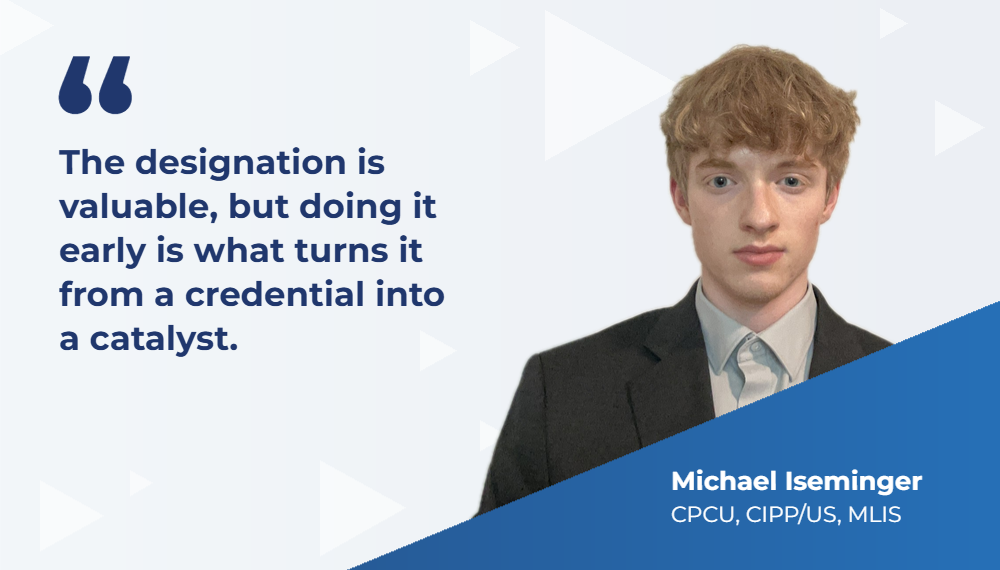
Question: Why did you start pursuing CPCU while still in college?
Answer: I started my CPCU journey early because I knew a 20-year-old walking into this industry needs to demonstrate technical depth to be taken seriously. But the true value of CPCU went well beyond credibility. It gave me the mental framework to understand risk across the whole industry, not just one corner of it, and the CPCU Society connected me to a network I wouldn't have had otherwise.
It's recognized everywhere in insurance, which matters, but what I'd tell another student is that the designation makes you a more informed, more capable member of the industry. It doesn't replace the years of hands-on experience it takes to truly master your craft, which I think is the most important piece. Nothing can replace that. But what it does is give you the right tools and the connections to get to that experience faster.
Q: How did you decide which skills and credentials to build?
A: I think about cyber risk as having three pillars: the insurance side, the technology side, and the privacy-law side. CPCU covered the insurance foundation, Security+ covered the technical side, and CIPP/US covered privacy law. I deliberately went after the hardest, most respected designation in each area. As someone young and new to the industry, I couldn't close the experience gap overnight, but I could build demonstrable depth across all three dimensions of the risk I wanted to work in. The credentials were a way to prove I understood the whole problem, not just one part of it.
Q: What have you learned through CPCU that you already use at work?
A: CPCU taught me to read coverage at the level of what's actually triggered versus what's assumed to be covered: the difference between first-party and third-party exposure, how endorsements narrow or expand a grant, where the real gaps sit. In my cyber work at Higginbotham that's been immediately useful, because the whole opportunity in the SME market is that businesses may think they're covered when they're not, which is the gap I've spent much of my time working to close.
But the deeper thing CPCU gave me was the ability to see risks from a macro point of view, understanding how a single account fits into a portfolio, an industry, a market. I've come to believe that's what separates people who are good at this job from people who actually make an impact. At Higginbotham I'm encouraged to think at that level, across cyber, D&O, E&O, and professional lines at once, and that breadth is a big part of why I was drawn to specialty broking. That macro view is the part of the work I enjoy most.
Q: How did you make time to study while balancing college and internships?
A: My approach to completing my CPCU was unorthodox, but it worked for me. Rather than studying a little each day around everything else, I'd wait for a week with no exams or major obligations and then clear the deck entirely: no other coursework, nothing but the CPCU exam I was working on. Blocking out that kind of uninterrupted, single-focus time is what let me move through the exams quickly. I passed every exam I sat for on the first attempt.
I'll be honest that most people can't realistically carve out a full week per exam, so the real lesson isn't the specific method. It's that fully immersing yourself in something is what makes you successful. Purposeful, focused effort is far more meaningful and efficient than just grinding through more hours. Fully diving into one thing beats doing a dozen things halfway. Find whatever version of that fits your life, and that's what will actually move you forward.
Q: How does earning CPCU early give your career an edge?
A: Earning CPCU at 20 isn't something I think of as a finish line. It's a head start that will continue to compound. Most people build this foundation in their late twenties or thirties. Having it now means every experience I take on early lands on top of a framework that's already there, so I'm learning faster and contributing sooner than I otherwise could.
At Higginbotham that's already playing out: I'm working across cyber, D&O, E&O, and professional lines while developing cyber as my specialty, and I can do that partly because the coverage foundation is already in place. Long term, what draws me is the strategic side of specialty risk: working at the level where cyber placement is a strategy question, not just a transaction. Looking across the whole book, understanding where the gaps are, and helping shape how the firm approaches the line. That macro view of placement is what I find most interesting, and it's the direction I want to keep growing in.
Getting the designation early didn't just open doors; it changed my ceiling. And the CPCU Society keeps that compounding, because the network turns into opportunities I wouldn't have found otherwise. If I could tell one thing to a student on the fence: the designation is valuable, but doing it early is what turns it from a credential into a catalyst.
Start Your CPCU Journey
Michael's story shows what can happen when you build a foundation before you need it. The macro view he describes reflects the critical thinking and strategic decision-making CPCU is designed to develop. You don't have to finish at 20 or clear a full week for every exam to build those skills. What matters is choosing a path that fits your goals and giving it focused effort.
CPCU is the leadership standard in risk management and insurance, and you can start whenever you're ready, including while you're still in school. To earn the designation, you'll complete eight courses plus a free ethics course and CPCU matriculation, which validates two years of experience in risk management or insurance and your commitment to the ethical standards of being a CPCU. The CPCU Society offers study groups, networking, and mentorship along the way. See what's included in the full CPCU experience.
Since 1909, The Institutes have been a not-for-profit focused on helping you succeed in risk management and insurance, wherever you are on your path.
Curious what CPCU looks like? Try the free CPCU sample courses to preview the content before you enroll.

About the Author
Our Skills Edge Team brings together insurance researchers and subject matter experts dedicated to advancing knowledge in risk management and insurance. Backed by more than 115 years of experience as a not-for-profit, the team at The Institutes is committed to educating, elevating, and connecting people and ideas to create a more informed, resilient world.