
Professional Development
How a Commitment to Learning Has Shaped Nicholas L. Glaser’s Insurance Career Path

Some careers in risk management and insurance grow within one specialty. Others move across functions, adding new skills with each step. Nicholas L. Glaser, CPCU, has done both. His insurance career path started in claims and led to commercial underwriting, the agency side, and now agency leadership. Along the way, he's never stopped learning. We asked Glaser what motivates him, how professional development has supported each move, and why The Institutes Designations have stayed part of his plan.
Question: With several designations to your name, what continues to motivate you to keep learning?
Answer: Part of being a professional must include a focus on continuous improvement—both to work toward mastery of your current skill set and to broaden it so you can work as effectively as possible with others across the many parts of your industry (or even in other industries). Professional designation programs have been my way of working toward those goals. Once I had about a dozen or so designations, I challenged myself to keep going and just didn't stop.
Q: Your career has spanned several areas across the insurance value chain. How has professional development supported those transitions?
A: Upon entering the insurance industry full-time after college, I knew I had to pursue the CPCU®. My father is a CPCU, and I understand the gravitas that designation has within the industry. When researching courses with The Institutes, I found other designations focused on specific areas of insurance. Being in claims at the time, I decided to pursue the Associate in Claims (AIC™) in addition to the CPCU. Those courses helped build my knowledge base, enabling me to be a true professional and serve as a go-to resource for others.
I took a kind of hybrid vertical/horizontal career path, which I credit partially to the knowledge gained through designations. In claims, I worked my way up to a senior adjuster before moving over to commercial underwriting. I believe holding the CPCU helped me make the transition from claims to underwriting much more seamlessly.
After several years in underwriting, I was promoted to senior underwriter, then moved to the agency side as an account executive, and now I'm in agency leadership. I completed the Associate in Management (AIM™) designation this year to support my transition into a management position within the agency.
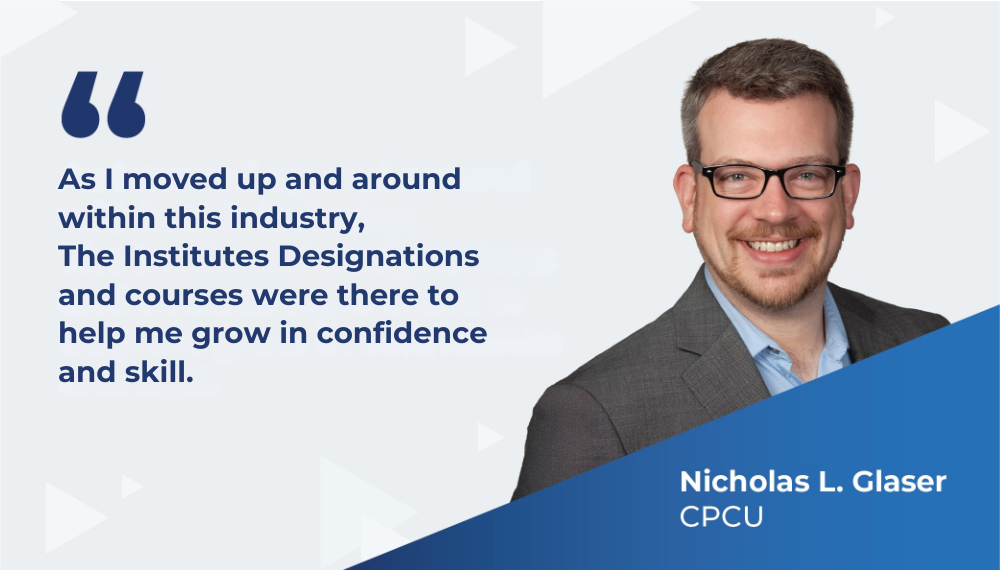
As I moved up and around within this industry, The Institutes Designations and courses were there to help me grow in confidence and skill. My professional development has also gone beyond just designation programs. I served as the 2018 president of the Greater Milwaukee Chapter of the CPCU Society, which helped me grow my leadership skills and spread the value of insurance education.
Q: Can you share a specific example of something you learned through an Institutes course or designation that proved especially useful on the job?
A: I honestly have takeaways from every single designation program I've completed. The CPCU offered the broadest application, providing a deep dive into both property and liability insurance and risk management, along with additional education in law, accounting, and operations as they relate to the insurance field. Studying the flood manual to earn the Associate in National Flood Insurance (ANFI®) designation was very helpful for understanding how the federal flood program operates and has been useful in assisting clients who need flood insurance. Most recently, I completed the Associate in Insurance AI™ (AIAI™) program. With AI being a hot topic in our industry, I'm very interested to see where it will go over in the next 4-5 years.
Q: How have you managed to balance studying with your career and leadership responsibilities, and what does your study routine typically look like?
A: Studying is pretty much always done on personal time. I happen to enjoy learning as much as I can about our industry, so it was never a burden for me to fit studying into my personal life to continue my studies. If you aren't using any of your personal time to make yourself a better professional, you will fall behind.
It has been a bit more difficult in recent years with young children at home, but there is still time to fit in studying here and there. For my typical study routine, instead of going through course content linearly, I read chapter summaries first, then take practice exams or chapter quizzes to see which areas I already know and which I need to focus on. Then I can tailor the rest of my studying to only those areas where I'm not already proficient.
Q: What has kept The Institutes Designations part of your professional development throughout your career?
A: The Institutes have designation programs that cover just about every facet of our industry. When curiosity gets the best of me, I've found myself pursuing designations outside my current roles to better understand that part of our business.
For example, while I don't work in a wholesale environment, I pursued the Associate in Surplus Lines Insurance (ASLI™) designation to understand better surplus lines products and how to work more effectively with our wholesale partners to obtain the best coverage for our clients. I also started earning designations in the life, health, and employee benefits spaces to broaden my horizons in this area, including the Professional Employee Benefits Consultant (PEBC™) designation from The Institutes. Learning that side of the business has opened opportunities for cross-selling and working with the benefits folks at our agency. More recently, I've really enjoyed The Institutes' focus on emerging risks and hot topic issues in risk and insurance by earning designations such as the Associate in Cyber Risk Management™ (ACRM™), AIAI, and the Associate in Catastrophe Risk and Resiliency™ (ACRR™). Programs such as these have kept The Institutes at the top of my professional development list.
Keep Learning, Wherever Your Career Goes
Nicholas's story is a reminder that career growth does not always follow a straight line. Each role can reveal new skills to build, new people to work with, and new parts of the field to understand.
For anyone thinking about what to learn next, his path offers a simple place to start: look at the work you are doing now, the opportunities you may want later, and the gaps that curiosity keeps pointing you toward. As a not-for-profit since 1909, The Institutes are committed to helping you build skills at every stage of your career, no matter where it goes.
Ready to plan your next move? Use CourseFinder to find a designation that fits where you want to go.

About the Author
Our Skills Edge Team brings together insurance researchers and subject matter experts dedicated to advancing knowledge in risk management and insurance. Backed by more than 115 years of experience as a not-for-profit, the team at The Institutes is committed to educating, elevating, and connecting people and ideas to create a more informed, resilient world.