
Risk Management Strategies
The New Era of Enterprise Risk Management: From Loss Prevention to Strategy

A decade ago, risk lived mostly in insurance and loss prevention. Today enterprise risk management sits much closer to strategy, as organizations face increasingly interconnected operational, reputational, and emerging technology risks. As these exposures continue to compound, so does the demand for risk management professionals who can help navigate evolving business challenges.
Organizational leaders are increasingly turning to risk managers to weigh near-term and long-term exposure with executive-level clarity. In fact, in a recent McKinsey survey of more than 200 senior executives and risk professionals, respondents said risk now plays a broader role within long-term strategy, rather than focusing only on financial concerns. This new level of influence points to a larger shift in how organizations approach risk. Read on to explore how enterprise risk management is becoming a driver of how organizations make decisions, and how you can upskill your employees to support this need.
What is Enterprise Risk Management?
Enterprise risk management, or ERM, is a connected way of managing risk and viewing exposure across your entire organization. Instead of treating risk in a bubble, ERM examines how risks in operations, compliance, finance, and other functions relate to and influence one another. It gives decision-makers a holistic picture of where your organization’s vulnerabilities lie, so risk management becomes part of how you plan for the future.
Understanding the Fundamentals of Enterprise Risk Management
At its core, enterprise risk management follows a continuous process that moves from identifying risks, to assessing them, to taking action and tracking the results over time.
Identifying Risk Across Your Organization
Effective risk management starts with a wide field of view. That means spotting exposures that cross operations, compliance, cybersecurity, finance, and technology rather than focusing on one function in isolation. There are proven techniques to help your team do this, including SWOT analysis, risk registers, and key risk indicators. Remember: risks that look small on their own can carry real weight once you see how they connect.
Assessing and Prioritizing Exposure
Not every risk deserves the same attention. During this step, your team should weigh the likelihood, impact, and near-term versus long-term consequences of a risk event, then analyze it to find the root cause, contributing factors, and points of failure. Framing exposure this way gives decision-makers the executive-level clarity they need to act on what matters most and manage resources with confidence.
Responding and Monitoring With Data
Once priorities are clear, your organization can decide how to treat each risk and then track it over time as conditions change. Be sure to encourage your team to utilize analytics and AI to efficiently and accurately identify exposures, quantify potential losses, predict future threats, and support risk-based decisions as new information arrives. In fact, organizations are already investing heavily in these capabilities, with the digital risk management market projected to grow from $11.89 billion in 2024 to more than $24 billion by 2029.
These fundamental steps provide a high-level overview of what your team needs to do. However, our online course, Executing ERM in Your Organization, shares advice from risk managers and chief risk officers to provide your team with practical strategies for developing your organization's enterprise risk management strategy.
What Are the Benefits of Enterprise Risk Management?
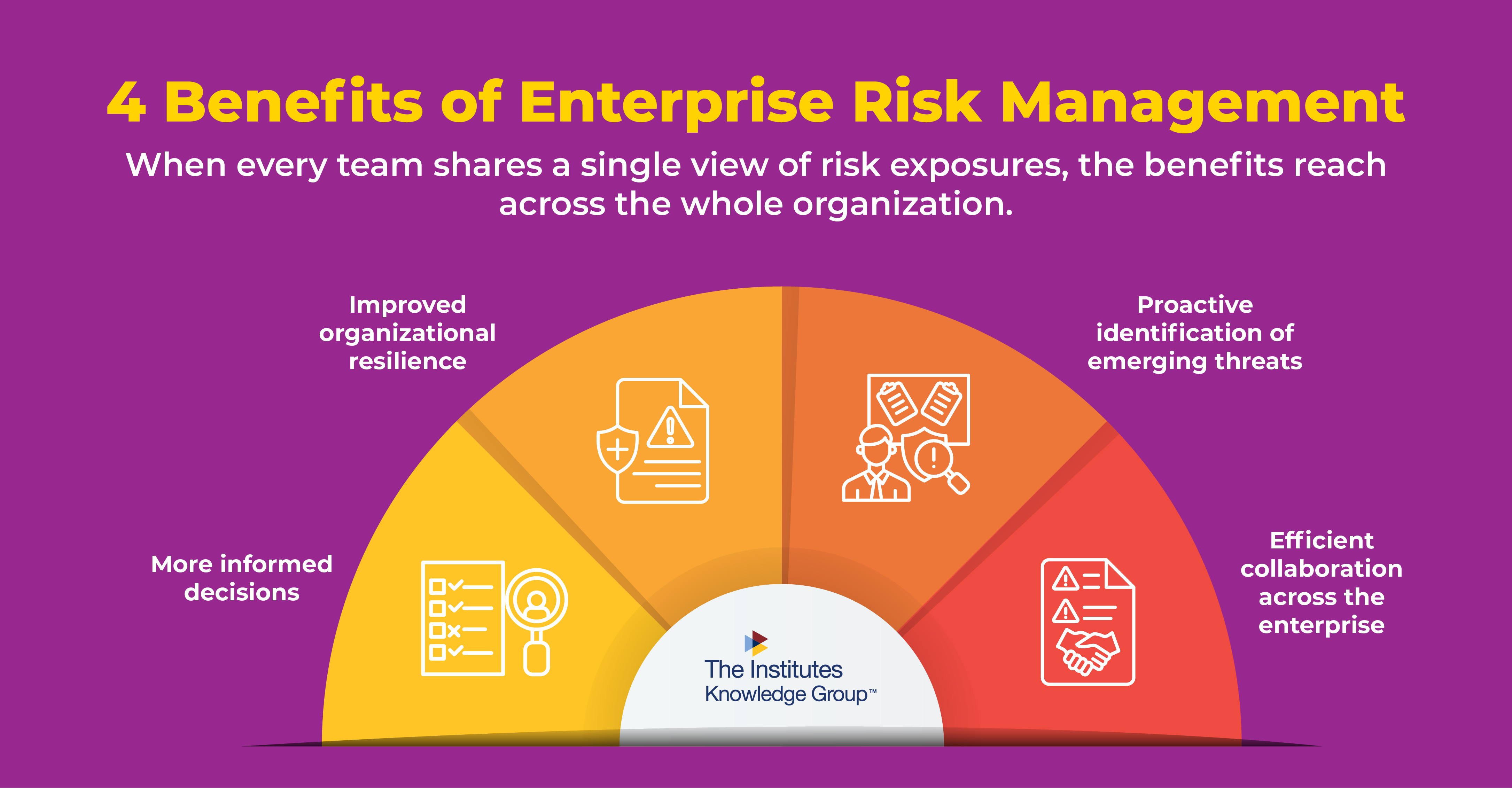
The payoff of a connected approach to risk management goes beyond fewer losses. When teams share one view of exposure, the benefits reach across the whole organization:
- More informed decisions. Leaders can see how a decision in one area creates risk in another, so they can weigh tradeoffs the business would otherwise miss.
- Improved organizational resilience. With response plans already in place, organizations can contain a disruption more quickly instead of reacting to it under pressure.
- Proactive identification of emerging threats. Organizations that are able to predict and prevent threats spend less time and money on damage control.
- Efficient collaboration across the enterprise. ERM gives operations, compliance, cybersecurity, finance, technology, and leadership a common way to identify and discuss risk, which reduces blind spots and helps teams work toward the same priorities.
Build More Resilient Risk Strategies
Being able to interpret risk data clearly, apply emerging technologies, and collaborate across functions is quickly becoming a baseline expectation for risk managers. Building those capabilities across your workforce is the first step to turning risk management into a real advantage instead of a safeguard.
The Institutes Designations’ new Associate in Risk Management (ARM™) was developed for exactly that need. ARM provides a practical framework that strengthens decision-making, improves organizational resilience, and supports more proactive risk management strategies. By incorporating topics like AI, data analytics, automation, and emerging technology, ARM helps your employees understand how traditional risk management strategies are evolving in today’s business environment. You can even try ARM and see if it's right for your team with this free sample course!

About the Author
Eric Czerwin is Director of Sales for The Institutes Knowledge Group. With a background in risk management and underwriting, he bridges strategic insight with practical execution while fostering long-term relationships. His focus is on empowering carrier workforces with enhanced skills and insurance field knowledge through organizational learning and development initiatives.