
General RMI Trends & Insights
The Future of Insurance Underwriting: Where AI Meets Human Expertise

For most of insurance history, an underwriter's role was clear: Assess a risk, determine whether or not to accept the exposure, and set the appropriate price. AI is now reshaping the insurance underwriting process, streamlining routine tasks and creating more opportunities for underwriters to focus on complex risks, strategic decisions, and the human judgement that remains essential to the role.
This means that the most valuable parts of the role still belong to the underwriter. Technology can extract data, triage submissions, and surface patterns at a rate no human can match, but pricing a complex account, questioning a model's recommendation, and weighing how each decision affects the broader portfolio still requires experienced professional judgement. That shift creates a practical challenge for organizations who must now deliberately develop expertise quickly that underwriters once built gradually through years of handling routine files.
What Does an Insurance Underwriter Do?
An insurance underwriter evaluates risk on an insurer's behalf, determining which accounts to write under which terms. In commercial lines, that work includes reviewing broker submissions, analyzing financial and loss information, assessing how an account's exposures interact, and setting the coverage, pricing, deductibles, and conditions that reflect the level of risk.
Underwriters also manage a book of business. Each decision affects the portfolio's loss ratio and growth, so experienced underwriters weigh individual accounts against the carrier's capacity and profitability targets. Historically, much of an insurance underwriter's day went to gathering and organizing that information before any analysis could begin. That's the part of the daily responsibilities AI is changing the fastest.
How is AI Evolving Insurance Underwriting?
AI is moving the field from manual case-by-case underwriting toward a machine-first and human-governed model, according to McKinsey. Automated tools support intake, risk selection, pricing, and issuance, while underwriters direct the process and own the decisions that require true expertise. This leaves more time for them to focus on complex accounts, negotiations, and portfolio strategies.
At the same time, an insurance underwriter needs to know how to govern the models themselves. AI tools learn from historical data, which makes them least reliable for more complex accounts and conditions that have changed since the data was collected. Underwriters need to understand what drives a model's output, recognize when a submission falls outside its limits, and document the reasoning behind any decision to override it. As carriers expand their use of AI, that oversight and attention to detail becomes a core part of the role.
Professional development also shapes retention. In a 2026 Carrier Management survey, 72% of underwriters said an employer's AI strategy would factor into future roles they choose, and 69% said their employer's approach made them more likely to stay.
How Do Underwriters Build Expertise When AI Handles Routine Work?
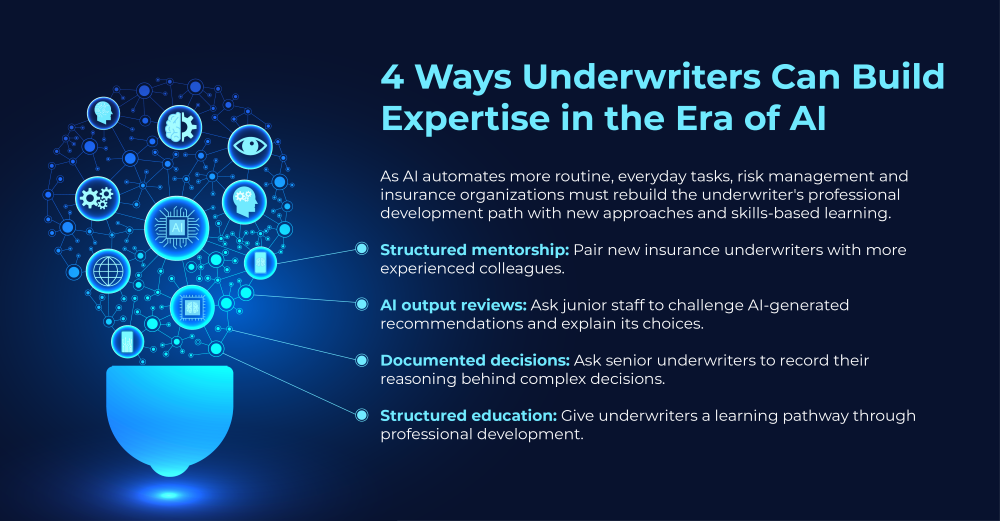
Commercial underwriting has traditionally functioned as an apprenticeship: junior professionals develop risk judgement by working alongside experienced colleagues before taking responsibility for complex accounts, according to Triple-I. However, AI is automating many of those entry-level tasks, so insurance companies now need to build that expertise deliberately. Several approaches can help rebuild your underwriters' professional development path.
- Structured mentorship. Pair each new insurance underwriter with senior colleagues for common types of file reviews to understand the reasoning behind important decisions and before veteran underwriters retire.
- AI output reviews. Assign junior staff to review and challenge AI-generated recommendations, then explain why a model got an account right or wrong to build the same analytical habits routine files once developed.
- Documented decision rationale. Ask experienced underwriters to record the reasoning behind complex decisions, creating a reference library that outlasts a single contributor's tenure.
- Structured education. Give underwriters a consistent foundation in risk analysis, pricing, and portfolio management that on-the-job experience alone no longer guarantees.
How to Prepare Underwriters for an AI-Driven Future
As AI, automation, and increasingly complex risks reshape insurance underwriting, strong human judgement is more important than ever. The Institutes Designations' new Associate in Commercial Underwriting (AU™) equips risk management and insurance professionals to make stronger decisions with modern skills by building the applied analytical, technological, and strategic expertise needed to confidently evaluate commercial risks and ensure overall portfolio health.
AU prepares your commercial underwriters to remain the human in the loop as technology evolves. You can even try AU and see if it's right for your team with this free sample course!

About the Author
Angela Pilotti, CPCU, ARe, is Head of Education at The Institutes, where she leads the development of innovative learning resources and assessments for risk and insurance professionals. With leadership experience spanning reinsurance, underwriting, and content development, she brings deep expertise to risk and insurance education.