
General RMI Trends & Insights
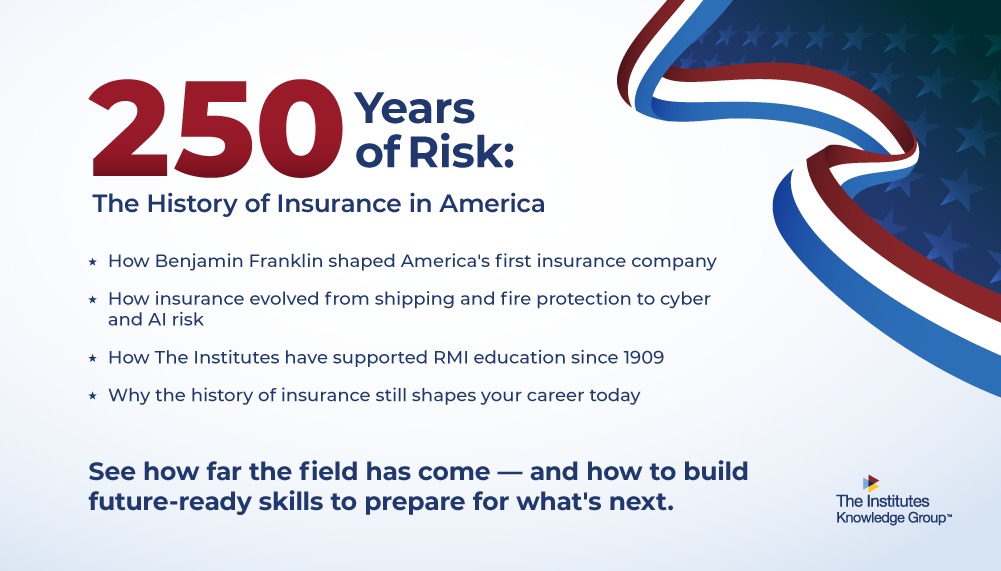
History of Insurance: 250 Years of Risk in America

In 2026, the United States marks its 250th birthday. It is a natural moment to look back at how people, businesses, and communities have managed uncertainty across those years. The history of insurance is part of that story.
Long before today's complex policies, predictive models, and AI tools, people needed practical ways to approach risk, recover from loss, and protect what mattered. The Institutes have been helping people build those skills in risk management and insurance (RMI) since 1909, nearly half as long as the nation has existed.
The risks have changed. The need for clear thinking, sound judgment, and practical RMI skills has not.
When Did Insurance Start?
The concept of sharing risk to soften loss stretches back centuries, but modern insurance has clearer roots in maritime trade. As European merchants moved goods across oceans, the need for organized protection against loss at sea became essential.
In the late 1600s, London became a center for that activity. Merchants, ship owners, and those willing to assume risk gathered at Edward Lloyd's coffeehouse, where deals were struck over shipping coverage. Those who agreed to cover a share of the loss signed their name under the policy terms, which is where the term "underwriting" comes from. That system eventually formalized into Lloyd's of London, still one of the most recognized insurance markets in the world.
The principle was simple: share the risk, price it carefully, formalize the agreement. That logic eventually crossed the Atlantic with early American settlers.
How Insurance Took Root in America
In colonial America, fire was one of the most visible risks. Cities were growing, buildings stood close together, and one fire could affect many families and businesses at once.
In 1752, Benjamin Franklin and his fellow firefighters helped found The Philadelphia Contributionship, often recognized as the nation's oldest successful property insurance company. Organized as a mutual insurance company, it brought policyholders together to share risk.
From the start, insurance was about more than paying after a loss. Buildings were inspected, risks were evaluated, and safer construction was encouraged. Those ideas still show up in underwriting, risk assessment, and loss control today.
What Was the First Insurance Company in America?
The Philadelphia Contributionship is widely recognized as the first insurance company in America. Its founding reflected a clear need: help people recover from fire loss while encouraging better decisions before loss happened.
That balance between protection and prevention remains central to RMI. Whether you work in claims, underwriting, risk management, or as an agent or broker, the work often starts with similar questions:
- What could go wrong?
- How likely is the risk?
- How severe could the loss be?
- What steps could reduce the impact?
The tools have changed. The questions remain familiar.
How Has Insurance Evolved Over Time?
The history of risk management and insurance evolution in America is closely tied to the country's own growth. New forms of commerce, transportation, property ownership, employment, regulation, and technology all created new exposures. Over time, RMI became more specialized and more central to how people and organizations make decisions.
Here is a simplified look at that evolution in America:
- 1750s: Fire insurance and mutual protection. Early property coverage helped communities share risk and recover from loss.
- 1800s: Commerce, growth, and regulation. As the economy expanded, insurance became more formalized. New Hampshire appointed the first insurance commissioner in 1851, laying the foundation for state-based insurance regulation.
- Early 1900s: Structured education. As insurance grew more complex, organized education became essential. The Institutes were founded in 1909 to help people build the skills the field was demanding.
- Today: Evolving risks, evolving skills. Cyber threats, catastrophe risk, data analytics, AI, and changing customer expectations are reshaping the field.
How Have The Institutes Evolved With RMI?
The Institutes have supported RMI education since 1909, nearly half as long as the United States has existed. What began as a resource for property-casualty insurance professionals has grown into a broader education ecosystem built around real-world skills. The Institutes Designations' CPCU®, introduced in 1942, has since become one of the most widely recognized professional credentials as the leadership standard for risk management and insurance.
As the field has changed, what people need to learn has changed with it. The Associate in Insurance (AINS®) builds a strong foundation in insurance principles and how coverage supports people, businesses, and communities. For the future of the field, the Associate in Insurance AI™ (AIAI™) helps you understand AI concepts, ethical considerations, and practical applications in RMI.
When risks change, learning helps you stay prepared.
Why Does Insurance History Matter for Your Career?
Understanding the history of insurance helps you see the purpose behind RMI work. This field is not only about policies, forms, or technical terms. It is about helping people prepare, respond, and recover when uncertainty becomes real.
A few things the past makes clear:
- Risk assessment helps people make better decisions. From early fire inspections to modern analytics, sound judgment starts with understanding risk clearly.
- Prevention remains part of the work. Insurance has always worked best alongside steps that reduce the chance or severity of loss.
- Credibility matters. People rely on RMI guidance during uncertain moments, which makes ethics, accuracy, and judgment essential.
- Learning helps you keep pace. New risks require new skills, and your ability to build them makes a difference.
Build RMI Skills for What Comes Next
The history of insurance shows a field built around practical problem-solving. From early fire coverage to today's complex risk landscape, the goal has stayed consistent: help people understand uncertainty, reduce loss, and recover when disruption happens.
The risks ahead will keep evolving, but the need for skilled, credible people will not change. When information feels overwhelming, it helps to learn from a source grounded in verified expertise. The Institutes bring more than 115 years as a not-for-profit dedicated to educating, elevating, and connecting anyone interested in risk management and insurance so they can succeed.
Ready to explore your next step? Use CourseFinder to find a learning path that fits your goals, or visit Getting Started to compare options.

About the Author
Our Skills Edge Team brings together insurance researchers and subject matter experts dedicated to advancing knowledge in risk management and insurance. Backed by more than 115 years of experience as a not-for-profit, the team at The Institutes is committed to educating, elevating, and connecting people and ideas to create a more informed, resilient world.