
General RMI Trends & Insights
Building Resilience: Risk Management Frameworks for Today’s Dynamic Environment

The risk management and insurance (RMI) landscape is shifting rapidly, and many professionals find themselves caught between reacting to immediate threats and preparing for what comes next. The good news is that structured, forward-thinking risk management frameworks can change that equation, empowering you and your organization to predict and prevent exposures rather than being purely reactive.
Let's explore how this approach can help you navigate today’s complex challenges with clarity and confidence.
Why Are Risk Management Frameworks Important?
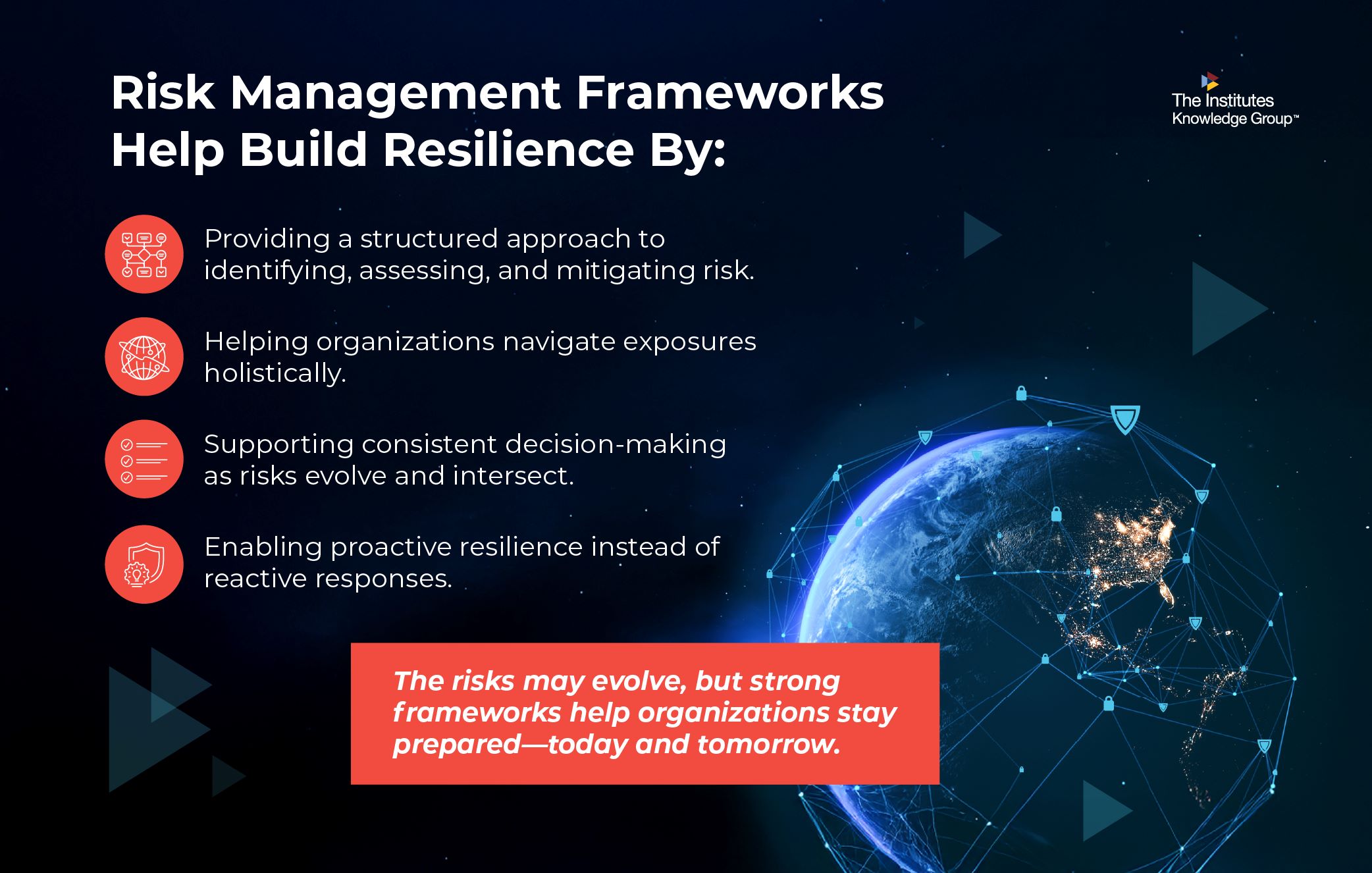
At its core, a risk management framework provides a structured approach for identifying, assessing, and mitigating risks. Rather than reacting to isolated events, frameworks help RMI leaders evaluate interconnected exposures, prioritize decisions, and consistently manage risk over time.
This approach is essential because traditional, siloed responses are no longer sufficient. Organizations today face a growing mix of cyber threats, natural disasters, and human-caused catastrophes. According to the Insurance Information Institute, global insured losses from natural catastrophes reached $145 billion in 2024, while the potential total loss from cybercrime climbed to $16.6 billion, up from $12.5 billion just one year prior. These types of exposures require a unified, strategic approach.
What Are the 4 Key Points in a Risk Management Framework?
When threats intersect across operational, financial, regulatory, and human areas, you need a process that accounts for all these layers simultaneously. A well-designed framework moves RMI teams from short-term fixes to long-term resilience by helping them address these four key points:
- Support risk mitigation and apply consistent processes across evolving scenarios.
- Translate complex data into action through structured analysis and prioritization.
- Strengthen collaboration across departments by aligning around shared insights.
- Adapt to change and use principles that remain relevant as threats evolve.
These capabilities are central to effective risk management strategies and essential for those seeking clarity on how to manage emerging risk in a dynamic environment.
How The Institutes Help You Stay Ahead of Evolving Risk
Backed by more than 115 years of experience as a not-for-profit, The Institutes are committed to educating, elevating, and connecting people and ideas to create a more informed, resilient world—especially in today’s ever-changing risk landscape.
The development of The Institutes Designations’ Associate in Cyber Risk Management (ACRM™) and the Associate in Catastrophe Risk and Resiliency (ACRR™) over the past year reflects this ongoing commitment. Both programs address the distinct challenges posed by cyber threats and catastrophe risks while remaining grounded in core risk management principles.
While the risks may differ, the goal is the same: to equip RMI learners with frameworks that last. By focusing on structured decision-making, risk assessment, and resilience, these programs help learners apply skills confidently, regardless of how threats change.
ACRM: Build Cyber Resilience
Although cyber incidents can ripple across operations, reputation, compliance, and financial stability, some might still see them as purely technical issues that are handled by IT. In addition, 87% of decision makers say their company lacks adequate protection against cyber-attacks, according to a 2024 global survey by Munich Re.
ACRM helps to address this gap. Now past its one-year milestone, the designation focuses on building durable skills that remain relevant even as cyber threats evolve. It emphasizes enterprise-wide frameworks that help learners evaluate vulnerabilities, understand coverage options, and address the human behaviors that often contribute to cyber incidents.
As recent learners explain:
“Cyber risk is ever-evolving and continues to be one of the fastest-growing exposures for organizations of all sizes. The Institutes Designations’ Associate in Cyber Risk Management™ (ACRM™) provided a deeper understanding of how to identify, manage, and monitor the rapidly changing threat landscape that organizations face today.”
- Nick Talarico, ACRM, AAI
“ From managing and assessing cyber risks to understanding holistic risk governance, leveraging data, and building successful compliance strategies, this program provided insights that are valuable across industries. I would definitely recommend ACRM to anyone interested in learning more about cyber risk management and becoming a more cyber-resilient employee.”
- Heather MacIver, CPCU, ACRM, AIS
Students gain skills that support collaboration across IT, leadership, and risk functions, ultimately strengthening cyber resilience over time.
ACRR: Turn Catastrophe Risk into Readiness
Catastrophe risks are also changing in scale and complexity. Natural disasters such as floods and wildfires increasingly intersect with human-caused risks like geopolitical instability and supply chain disruption. Managing these exposures requires a holistic view that goes beyond insurance placement alone.
The recently released ACRR program helps address this reality. ACRR applies risk management frameworks to both natural and human-caused catastrophes, helping learners anticipate impacts, evaluate financial consequences, and strengthen organizational and community resilience.
After completing ACRR, RMI professionals will be better prepared to:
- Mitigate natural catastrophe risks such as floods, wildfires, and earthquakes.
- Manage human-caused risks like geopolitical disruption and industrial accidents.
- Anticipate outcomes by examining the interconnected nature of catastrophe risks.
- Spot warning signs before catastrophes negatively affect business operations.
Collectively, these skills support more informed strategic planning and risk management decisions as catastrophe risks grow more complex and interconnected.
From Frameworks to Forward-Thinking Risk Decisions
Lastly, as cyber threats intensify and catastrophe exposures expand, one truth remains clear: structured risk management frameworks will remain central to effective decision-making. Education that combines evergreen principles with emerging insights ensures you and your team stay prepared, not surprised.
The risk landscape has changed, but so have the tools available to manage it. By embracing frameworks grounded in proven principles and designed for today's challenges, organizations can move forward with greater strategy and resilience.
Ready to strengthen your risk management approach? Try the free sample courses to see how ACRM and ACRR can help build your skills and prepare your community for emerging risks. The next step toward greater resilience starts today.

About the Author
Our Skills Edge Team brings together insurance researchers and subject matter experts dedicated to advancing knowledge in risk management and insurance. Backed by more than 115 years of experience as a not-for-profit, the team at The Institutes is committed to educating, elevating, and connecting people and ideas to create a more informed, resilient world.