Professional Development
Risk Management and Insurance Goal Setting: A Practical Approach for 2026

New technologies, emerging risks, and evolving market dynamics are reshaping how risk management and insurance (RMI) professionals work and what skills matter most. In this environment, setting intentional professional development goals isn't optional. It's your competitive advantage.
The good news? Risk management and insurance goal setting doesn't require predicting the future or mapping out every career move. Instead, it's about identifying where growth will make the biggest impact for you personally, then taking realistic steps to get there. This approach keeps you focused, motivated, and adaptable, no matter what changes come your way.
Ready to build an RMI career that keeps pace with your field? Let's explore how to set meaningful professional development goals that actually stick.
What Should You Focus on for Risk Management and Insurance Professional Development?
Many professionals set ambitious resolutions in January, only to abandon them by February. The difference between goals that fade and goals that stick isn't ambition—it's strategy.
Focus on Progress, Not Perfection
Career growth rarely happens all at once. Instead of aiming for a perfect outcome, focus on steady progress. Small steps, like completing a course or building confidence in a new skill, can add up over time. Celebrate these milestones. They matter.
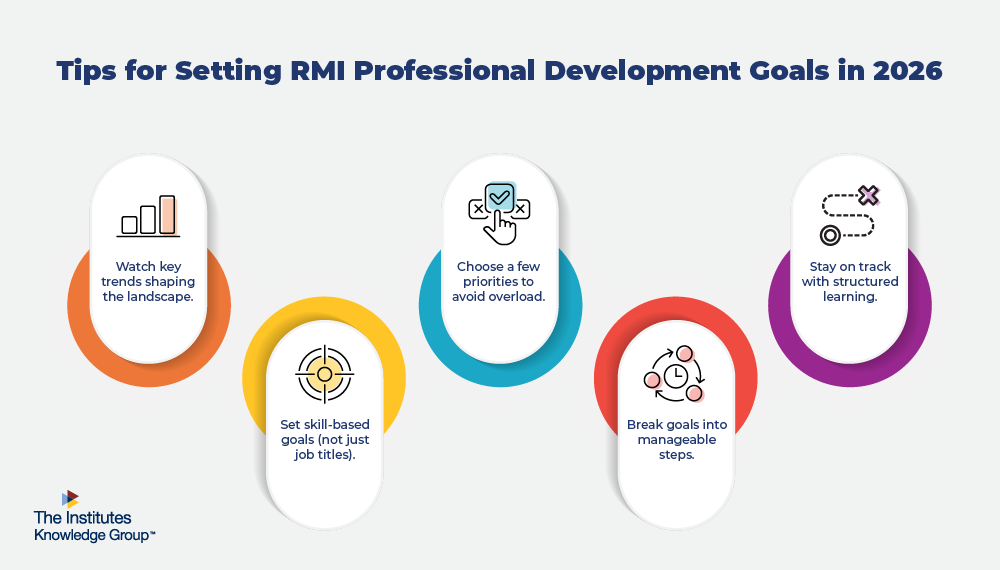
Connect Goals to Skills, Not Just Job Titles
A promotion sounds great, but here's what's more valuable: the skills that make you promotable. Skills-based goals help you improve your effectiveness today while preparing you for tomorrow's opportunities. They're also easier to measure and control.
Set Clear Priorities to Avoid Overload
Trying to do everything at once can lead to burnout. By narrowing your focus to a handful of meaningful goals, you create space to actually follow through. Consider setting SMART goals that are specific, measurable, attainable, relevant, and time-bound.
What Trends Are Shaping Risk Management and Insurance in 2026?
Your specific goals should reflect what's actually changing in the risk management and insurance community. Understanding these shifts helps you make strategic choices about where to invest your learning time. Several trends are reshaping professional priorities right now:
- Technology modernization and AI integration continue to shape insurance operations, with organizations expanding the use of data, analytics, and AI to support underwriting, claims, and decision-making, according to Deloitte’s 2026 Global Insurance Outlook.
- Deloitte’s report also emphasizes that workforce adaptability and readiness are increasingly important as roles evolve in digital and data-rich environments.
- Evolving customer expectations are pushing insurers to expand digital access and deliver more personalized, customer-centric experiences, according to Capgemini.
- The Insurance Information Institute recently shared a report on how climate-related risk pressures remain a key factor, with persistent weather-related losses and elevated replacement costs influencing pricing, underwriting, and availability.
- Cyber risk and digital vulnerabilities continue to rank among the top global business risks, reflecting growing digital complexity and interconnected systems, according to Risk & Insurance.
Skill-based goal setting helps you stay adaptable and prepared, no matter how the landscape changes.
Ways to Reach Your Risk Management and Insurance Goals
Setting a goal is one thing. Knowing where to start is another. Here are five common professional development goals for risk management professionals in 2026—and concrete pathways to achieve them:
Master Insurance Fundamentals
If you are relatively new to RMI or just want to strengthen your core knowledge to feel more confident in your role, The Institutes Designations’ Associate in Insurance (AINS®) builds a strong foundation in insurance principles. Time commitment: 3–6 months.
Build Data Literacy
Ready to use data more effectively in risk analysis? The Associate in Insurance Data Analytics® (AIDA™) teaches you to apply analytics across the insurance value chain without requiring a technical background. Time commitment: 6–9 months.
Understand AI Applications
Want a high-level grasp of how AI is transforming risk management? Our AI online courses take as little as one hour each and introduce practical applications across underwriting, claims, marketing, and more.
Strengthen Cyber Risk Knowledge
The Associate in Cyber Risk Management™ (ACRM™) helps you identify, manage, and mitigate cyber risk while building organizational resilience. Time commitment: 6–9 months.
Develop Leadership Skills
For long-term career growth, CPCU® is widely recognized as the leadership standard in risk management and insurance, helping you build the practical skills needed to lead the future. Time commitment: 18–24 months.
How to Stay on Track All Year Long With Your RMI Goals
Goals are only as good as your follow-through. These strategies help you maintain momentum. Think of them as simple ways to turn good intentions into steady progress.
- Break big goals into manageable milestones. Dividing goals into monthly or quarterly checkpoints makes them easier to manage and helps you see progress along the way.
- Measure progress in meaningful ways. Completion matters, but so do confidence gains, skills you’ve applied to real work, and problems you’ve solved using new knowledge.
- Use structured learning for accountability. Formal courses and programs provide built-in motivation and deadlines, making it easier to stay committed throughout the year.
Start Your 2026 Professional Development Journey
You don't need a perfect plan to move forward. Choose one meaningful goal aligned with where you want to grow in your RMI career, explore learning options that support it, and commit to steady progress.
Professional development isn't just about staying current—it's about building the skills and confidence to shape your career intentionally. Start now, stay focused, and trust that small, consistent steps lead to meaningful growth.
Ready to achieve your RMI goals? Explore all of our learning pathways today.

About the Author
Angela Pilotti, CPCU, ARe, is Head of Education at The Institutes, where she leads the development of innovative learning resources and assessments for risk and insurance professionals. With leadership experience spanning reinsurance, underwriting, and content development, she brings deep expertise to risk and insurance education. .