Risk Management Strategies
How to Build Risk Management Strategies for Better Business Decisions

Your risk management strategies only work if the people who approve them can see the options, the tradeoffs, and the decision in front of them. Making that case is a skill you can put to work right away. In the 2026 State of Risk Oversight study from NC State University's ERM Initiative and AICPA, 74% of executives and board-level leaders said their organizations had experienced a significant operational surprise within the past five years. Effective risk management strategies help you respond more deliberately by selecting the right treatment options and presenting them in terms decision-makers can use.
Read on for the main treatment options, how to choose among them, and how to make the case for what you recommend. And if you want to go deeper, The Institutes Designations' NEW Associate in Risk Management (ARM™) uses realistic business scenarios to help you build more resilient risk strategies.
What Are the Main Risk Management Strategies?
A risk management strategy is the approach an organization takes to address a specific exposure. Most treatment decisions draw from four core options:
- Avoidance: Choosing not to begin or to discontinue an activity that creates a particular exposure.
- Reduction: Using controls to lower the likelihood of a loss, limit its severity, or both. This is where a predict and prevent approach does its work.
- Transfer: Allocating defined financial consequences to another party through tools such as insurance or contractual agreements.
- Retention: Intentionally accepting and preparing to finance some or all of the potential loss.
These risk management techniques are not mutually exclusive. An effective strategy often combines several of them so each addresses a different part of the exposure. They also assume the exposure has already been identified and prioritized, which is the job of a risk management framework.
How Do You Choose the Right Combination?
No single treatment works for every risk. Your choice should reflect the likelihood and potential severity of the loss, the organization's objectives and risk tolerance, available capital, the cost and feasibility of controls, and any coverage or contractual obligations.
Consider a distributor concerned about a warehouse fire. It might avoid part of the exposure by no longer storing a particularly hazardous product. It could reduce the likelihood or severity of loss through inspections, safer storage practices, and sprinkler systems. Property insurance could transfer defined financial consequences, while a deductible and funded reserve would retain a manageable portion of the loss. Backup inventory at another location could further limit disruption.
The strongest recommendation is not necessarily the option that removes the most risk. It is the combination that supports the business objective at an acceptable cost while making the remaining exposure clear. Before you recommend an approach, identify what the organization is protecting, what constraints affect the decision, and how much uncertainty remains.
Build the Strategy Around the Decision
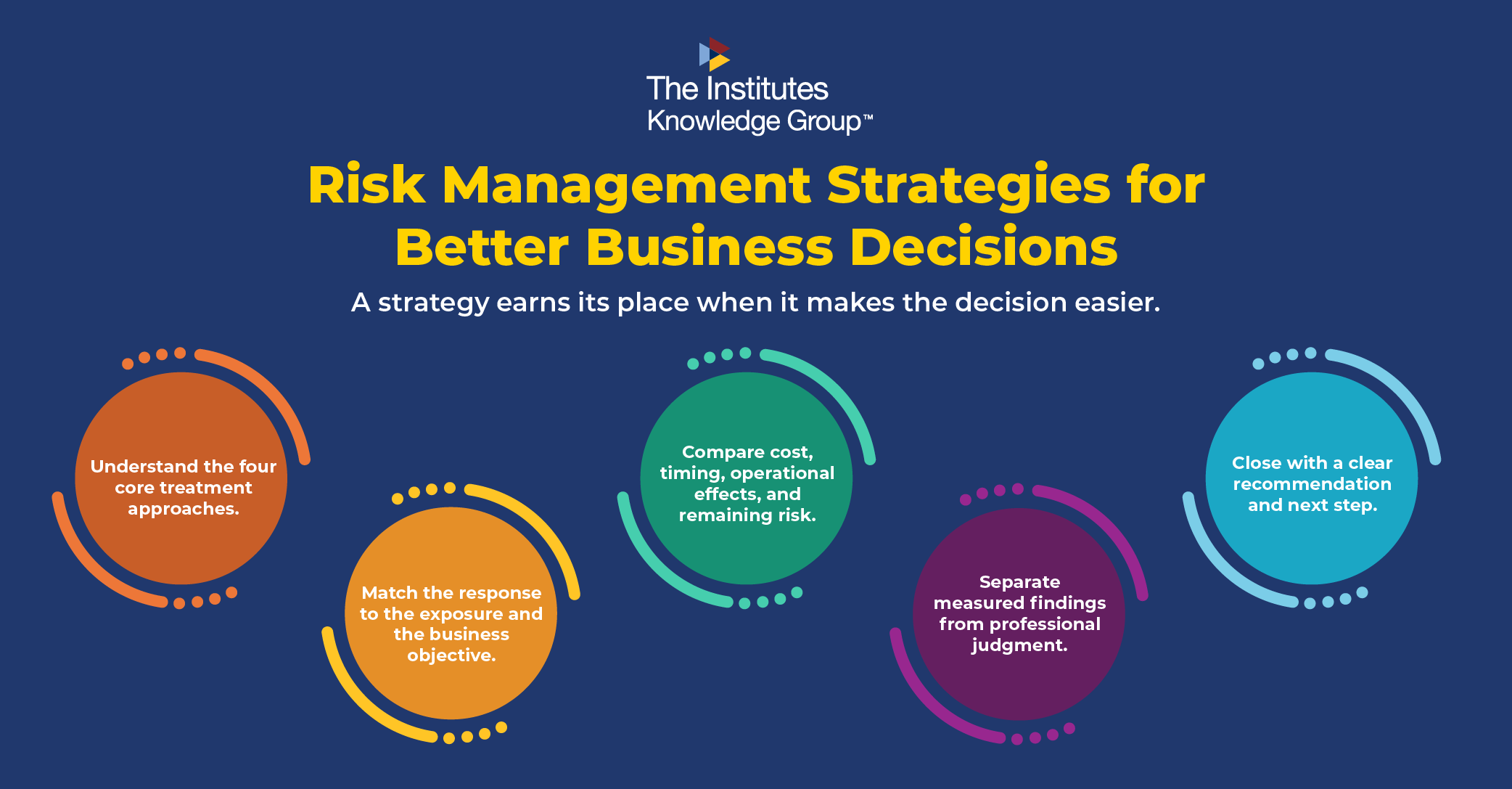
A risk report often begins with everything you found. A stronger strategy begins with the decision that needs to be made: Is the organization being asked to approve funding, change a process, revise a contract, select coverage, or accept a defined level of risk?
Once that decision is clear, frame the analysis for the person who must act. Finance may focus on capital, cash flow, and the relative cost of each option. Operations may prioritize continuity, downtime, and implementation demands. Compliance may examine legal obligations and potential penalties. Senior leaders may need to understand the strategic tradeoff and how the recommendation supports broader organizational goals.
The underlying exposure does not change. The framing makes its business relevance explicit. That matters most when you need to guide a decision without controlling the budget, process, or team involved. It is also why enterprise risk management has moved closer to business strategy in recent years.
Make the Tradeoffs Clear
A strong recommendation makes the available choices and their consequences easy to compare. Quantify expected costs and potential losses when credible data is available, but distinguish measured estimates from assumptions and professional judgment. Being clear about uncertainty strengthens your credibility and helps the decision-maker understand how much confidence to place in each figure.
When feasible, present more than one viable approach using consistent criteria. Compare the expected cost, potential loss reduction, implementation time, operational effects, and exposure that would remain. Then recommend the option that best balances those factors.
Close with the specific decision or action needed and when it is needed. A useful recommendation should allow the decision-maker to answer three questions quickly: What are the choices? What does each choice mean for the organization? What needs to happen next?
Build Practical Skills for Better Risk Decisions
The strongest risk management strategies combine sound analysis, business judgment, and clear communication. All three are learnable, and helping students build them is what The Institutes have done since 1909. As a not-for-profit, The Institutes are committed to helping you succeed by educating, elevating, and connecting those interested in risk management and insurance to create a more informed, resilient world.
The NEW Associate in Risk Management (ARM™) develops each of the three skills above through realistic business examples and scenario-based learning. Try the free ARM sample course in as little as 30 minutes so you can see how that works before you commit!

About the Author
Adam Carmichael, CPCU, is President of The Institutes Knowledge Group. He leads the strategic development and delivery of courses and exams for risk management and insurance designation programs. He also oversees new course creation to ensure The Institutes’ education aligns with professional development needs. With more than 25 years in research and assessments, he brings deep expertise in professional development.