Professional Development
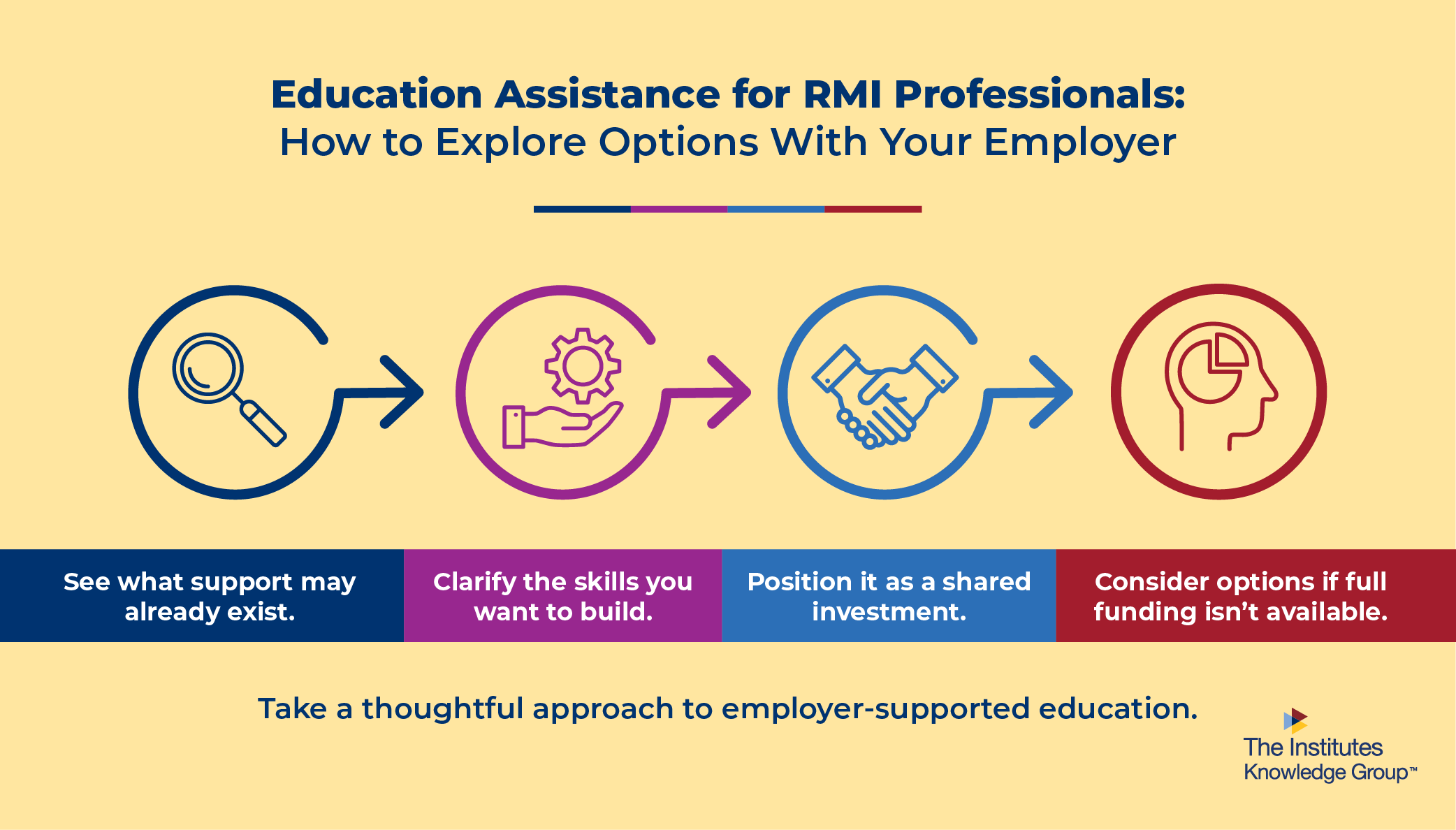
Education Assistance for RMI Professionals: How to Explore Options With Your Employer

As the risk management and insurance (RMI) landscape evolves, staying current with new skills is essential, but the cost of continuing education can add up quickly. Fortunately, many employers already offer some sort of education assistance, even if the opportunity isn't heavily advertised.
Here, we will walk you through the process of identifying available support, preparing your case, and having a confident conversation with your employer about education assistance benefits. With the right preparation and approach, you can unlock support that makes professional development more accessible and affordable.
What Education Assistance Support Might Be Available?
Before you assume you're funding education entirely on your own, explore what your employer already offers. Support comes in many forms, and you may have options beyond traditional reimbursement.
Common types of employer education support include:
- Cost coverage: Employers may pay for study materials or exams, either fully or partially.
- Pre-paid agreements: Some organizations purchase subscriptions or use learning management system (LMS) integrations so you know what’s covered.
- Direct billing arrangements: Your employer gets billed directly at checkout, so you avoid out-of-pocket costs.
- Tuition-assistance platforms: Services like EdAssist and GUILD help manage employer reimbursement for education.
- Professional memberships: Employers may cover memberships such as the CPCU Society, which includes learning resources and study support.
- Paid time off: PTO may also be available for studying or taking exams.
Some organizations formalize these through structured assistance programs, while others handle requests case by case. Many professionals find that support exists simply because they asked.
Get Clear on Your Professional Goals First
Preparation starts with clarity. Before requesting education assistance, take time to define what you want to achieve and why it matters.
Choosing an RMI designation or course that aligns with your professional goals is an important first step. If you’re unsure where to begin, try our free CourseFinder and view our guide to setting RMI professional development goals. You can also explore a variety of free sample courses to get a feel for the content.
It can also help to pause and ask yourself a few focused questions:
- How does this course material apply to my current responsibilities?
- What RMI role am I working toward?
- What specific skills will I gain, and how can I apply them?
- How does this benefit the organization?
Employers also look for credibility. When validating the skills of the designation to your job or professional career aspirations, it helps to show it’s backed by a trusted, established source.
For more than 115 years, The Institutes have served as a not-for-profit dedicated to educating, elevating, and connecting people and ideas to create a more informed, resilient world. That legacy of trust, paired with structured courses and built-in study support, reinforces that you’re pursuing a respected program designed to deliver measurable, job-ready skills.
How to Start the Conversation About Assistance for Professional Development
A thoughtful approach can help create a more productive conversation with your employer about education assistance.
Be specific about the expertise you’ll gain and how you’ll put it into practice. Rather than saying a course will make you "more knowledgeable,” explain the practical skills you’ll develop and where they’ll make an impact. For instance, if you wanted to pursue The Institutes Designations’ CPCU®, you could say, “I’ll be able to recommend risk management approaches to internal and external stakeholders to maximize our organization's strategic potential.”
This sample employer support letter can help you clearly communicate your goals, the value of your preferred program, and how it supports your role.
What If There Isn’t a Formal Education Assistance Program?
Many organizations actively support professional development through structured education assistance programs. However, some may not have a formal policy in place.
If that’s the case, it doesn’t mean support isn’t possible.
You might consider:
- Ask about partial support, such as covering exam fees, materials, or providing PTO.
- Explore available discounts or the CPCU scholarship, if that aligns with your goals.
- Consider starting with standalone online courses or Micro-Certs to manage the cost of continuing education.
- Look into using 529 funds, if applicable, for eligible professional education expenses.
Even without a formal program, many organizations recognize the value of continued learning in risk management and insurance when it’s clearly connected to business impact.
Turn Interest into Impact
Asking about education assistance is a normal, and increasingly important, part of professional growth in risk management and insurance. When you approach the conversation with clarity and purpose, you’re not just asking for support. You’re demonstrating initiative and long-term commitment to your role.
Whether your employer offers full funding, partial assistance, or needs time to review your request, the process itself strengthens your ability to connect learning with business impact.
If you’re ready to map out your next move, begin with our Getting Started guide to explore your options and identify the learning path that aligns with your goals.

About the Author
Diane Hanlon is Head of Sales and Market Development at The Institutes, where she leads sales strategy and client partnerships. She works with Learning and Development leaders to design workforce learning pathways and serves on the Board of the Society of Insurance Trainers and Educators.