General RMI Trends & Insights
Ethical Risk Management and Insurance in a Changing World

March is Ethics Awareness Month, but ethical decision-making matters year-round, especially as the risk management and insurance landscape continues to evolve. AI, automation, and other emerging technologies are changing how work gets done with greater speed and efficiency. At the same time, they also introduce ethical risks and questions about fairness, transparency, accountability, and trust.
That is why ethics is not a side topic. It is a practical skill that helps you make sound decisions when the path is not always clear. Whether you are evaluating data, communicating with customers, or using new tools in your workflow, ethical judgment helps you move forward with integrity.
What Is Ethical Risk Management?
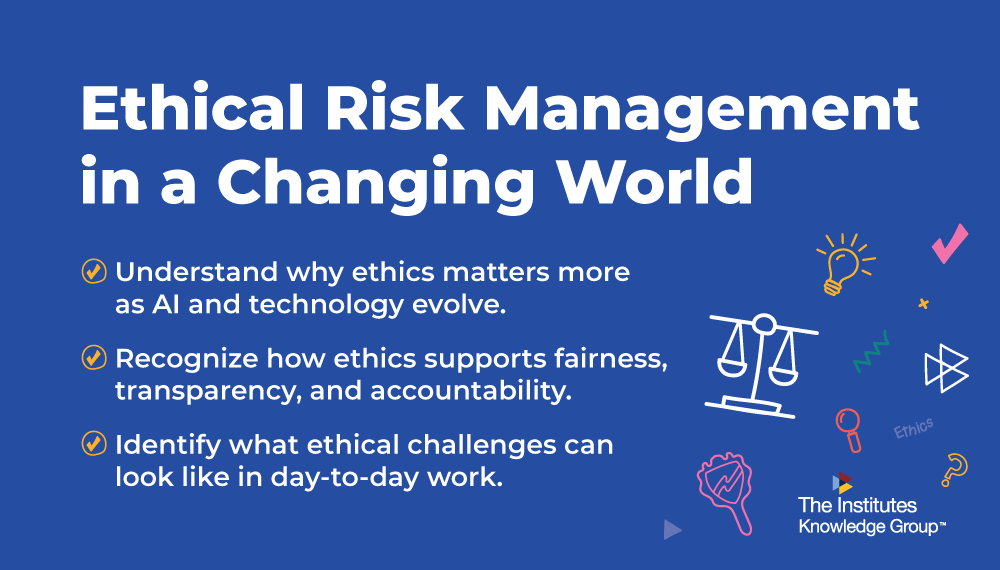
Ethical risk management means making decisions that are not only effective, but also fair, responsible, and aligned with professional standards. In risk management and insurance, your decisions can affect customers, colleagues, organizations, and communities. That makes ethics inseparable from technical expertise.
In practice, ethical risk management is not just about avoiding the wrong choice. It is about building habits that support sound judgment, clear communication, accountability, and trust. Those habits matter even more when you are working with fast-moving technology, complex information, or competing priorities.
For example, you may have access to a tool that helps you process information faster. But using it responsibly still requires you to ask important questions. Is the output accurate? Is the process fair? Can you explain the result clearly to the people affected by it? Those are not abstract concerns. They are part of everyday professional decision-making.
Why Does Ethics Matter More Now?
New technology can help professionals work faster and uncover insights more efficiently. But speed does not replace judgment. In many cases, it raises the stakes.
In their bulletin on insurers' use of AI, the NAIC notes that artificial intelligence can support innovation, efficiency, and accuracy, while also creating risks such as inaccuracy, unfair discrimination, data vulnerability, and a lack of transparency or explainability.
That same balance shows up in broader insurance thought leadership. Geneva Association's report on responsible AI in insurance emphasizes that insurers need clear governance, transparency, accountability, and employee training to use AI responsibly. In other words, innovation works best when ethical decision-making is built into how new tools are introduced, used, and monitored, not added after problems appear.
That matters in risk management and insurance because many everyday decisions now sit closer to questions like these:
- Is this process fair to the people it affects?
- Can this decision be explained clearly?
- Is data being used responsibly?
- Does efficiency support better outcomes, or just faster ones?
These are practical questions, but they are also ethical ones. As your work within risk management and insurance changes, your ability to navigate them becomes even more valuable.
What Do Ethical Challenges Look Like in Day-to-Day Work?
Ethical considerations are often part of routine work, even when they are not immediately obvious. You might use an AI-assisted output without fully understanding its limitations. You might feel pressure to move quickly while still trying to ensure accuracy and fairness. You might need to explain a difficult decision to a customer who needs reassurance, not just information. Or you might find yourself balancing business goals with responsible judgment when the right answer is not immediately obvious.
These moments may seem small, but they shape trust over time.
That is also why ethics remains so relevant as organizations continue adopting digital tools. New capabilities can improve performance, but they do not eliminate the need for people to ask better questions, apply sound judgment, and communicate with integrity. In fact, the more advanced the tools become, the more important those human skills are.
How Does Ethics 311 Help You Build These Skills?
At The Institutes, Ethics 311: Ethical Decision Making in Risk and Insurance is a free online ethics training course required for all Institutes Designations. It is also approved for state continuing education (CE) credits. It can be completed in just a few hours, only needs to be taken once, and is designed to help you identify and work through ethical dilemmas you may encounter in your day-to-day work.
That matters because ethics is not something to save for later in your career. It is a core professional skill. Technical knowledge helps you understand the work. Ethical judgment helps you apply that knowledge responsibly.
That same focus carries into The Institutes Designations' new Associate in Insurance AI™ (AIAI™), which includes ethics-related content in its courses. As the first designation of its kind focused on AI in risk management and insurance, it helps you apply ethical AI principles so you can spot bias, transparency gaps, and responsible-use concerns. It also helps you recognize AI's limits so you know when AI can support your work and when it should not.
Why Is Ethics 311 Offered for Free?
Making ethics education accessible helps strengthen the profession as a whole. In a field where decisions can shape financial outcomes, customer confidence, and long-term relationships, ethical standards should not feel out of reach.
We offer Ethics 311 at no cost to learners because we believe that ethics should be a shared foundation, not a barrier. When more risk management and insurance professionals have access to a common framework for ethical decision-making, it supports stronger judgment across the profession.
Build Your Ethical Decision-Making Skills Now
Ethics matters in risk management and insurance because the work matters. It shows up in everyday decisions, in conversations with customers, in how new tools are used, and in how professionals respond when the right answer is not immediately obvious.
That is why Ethics 311 remains such an important part of the learning journey at The Institutes. It gives you a practical framework for navigating ethical dilemmas, strengthening accountability, and making decisions with integrity.
When information feels noisy and technology keeps changing, it helps to learn from a source grounded in verified expertise. Backed by more than 115 years as a not-for-profit, The Institutes continue to support learners with education designed for real-world decisions.
Complete Ethics 311: Ethical Decision Making in Risk and Insurance to strengthen your ethical decision-making skills, and visit the Ethics in Risk and Insurance Student Toolkit for additional course information and shareable resources.

About the Author
Adam Carmichael, CPCU, is President of The Institutes Knowledge Group. He leads the strategic development and delivery of courses and exams for risk management and insurance designation programs. He also oversees new course creation to ensure The Institutes’ education aligns with professional development needs. With more than 25 years in research and assessments, he brings deep expertise in professional development.