How Can You Leverage AI in Learning and Development to Enhance the Employee Experience?
Leverage AI in learning and development efforts to enhance the employee experience by automating repetitive tasks, turning raw data into actionable insights, and helping your team work smarter. It’s no secret that AI is becoming a practical part of organizations’ day-to-day operations, and this is especially true for learning and development (L&D) teams in the risk management and insurance sector.
For instance, the Global Corporate Training Market was valued at $352 billion in 2024 and is expected to grow at an annual rate of 11.7% until 2030, according to a report from Research and Markets. This growth highlights a clear opportunity: Use AI in learning and development to create more consistent, personalized employee experiences and drive more engagement with professional development programs.
Explore how to use AI in learning and development, from onboarding to exam preparation.
AI Can Support Your L&D Onboarding Efforts
AI can improve L&D onboarding by creating structured, scalable learning experiences that adapt as your organization grows. It can help personalize training, recommend role-specific content, and streamline onboarding workflows to support faster employee ramp-up.
Help Outline Your L&D Onboarding Plan
Effective onboarding begins before a new hire’s first day, and AI can help L&D teams bring more structure to your planning process by mapping learning content to specific roles and business goals. By analyzing job requirements, available learning resources, and historical onboarding data, AI can help identify what training should be introduced early and what can be phased in over time. As priorities evolve, it can also help identify knowledge gaps and suggest updates.
Benchmark Skills Across Risk Management and Insurance Roles
AI tools can help benchmark key skills by analyzing historical performance data and emerging skill trends to define what employees should know within their first 30, 60, and 90 days. New hires often arrive with varying levels of experience, which can make it difficult to set consistent expectations. Benchmarking skills creates a shared baseline across roles while still accounting for specialized technical training in areas like claims, underwriting, or risk management.
AI Can Standardize the Employee Experience
Standardizing the employee experience makes professional development easier to navigate and more consistent across the organization. When learning requirements, resources, and expectations are clear, employees are more likely to stay engaged and take full advantage of available training opportunities.
Automate Repetitive Tasks
AI can automate repetitive L&D tasks like scheduling training, sending reminders, tracking completions, and generating reports for L&D teams. AI technology is well suited to automate these routine tasks, including:
- Tracking course completions and learning progress
- Logging professional development hours and compliance requirements
- Updating learner records across systems
Plus, implemented AI and automation helps reduce errors, keeps information current, and gives your team more time to focus on more strategic priorities.
Answer Routine Questions in Real Time
Employees usually have similar questions about learning requirements, progress, or next steps—especially as you further standardize their experience. AI-powered tools can deliver immediate answers by drawing from approved learning plans, policies, and FAQs. This ensures employees get reliable information without waiting for manual follow-up. It also reduces the volume of one-off messages that can slow down your team.
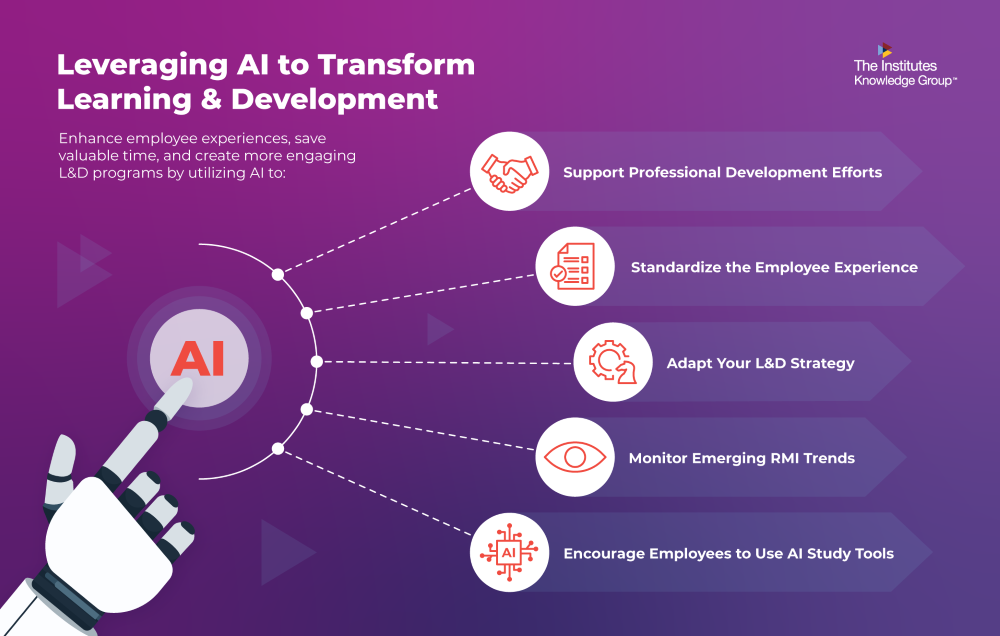
AI Can Adapt Your L&D Strategy
As the RMI landscape evolves, leveraging AI in learning and development efforts will only become more crucial to deliver relevant and timely training programs.
Monitor Emerging RMI Trends
Regulatory updates, best practices, and skill requirements are constantly changing. AI-driven tools can help monitor emerging RMI trends and identify what skills are becoming most in demand. Rather than relying solely on periodic manual reviews, you can gain a more continuous view of where your L&D strategy may need to shift.
Turn Employee Feedback into Actionable Insights
Employee feedback is invaluable, but analyzing it at scale can be challenging. AI can review all your learning data to surface patterns that might be difficult to identify manually, such as:
- Common skill gaps across roles or experience levels
- Courses that consistently drive engagement or drop-off
- Timing issues, like when learning is introduced too early or too late
These insights help L&D teams move beyond anecdotal input and make decisions based on organization-wide trends.
Build Personalized Learning Pathways
Structured learning pathways are an effective tool to help employees plan their professional development in a way that aligns with your organization’s goals. Further personalizing these pathways to each employee’s personal career goals and interests can make learning feel more relevant and engaging. AI can suggest courses and designations based on role progression, existing expertise, and predictions on future skill trends.
AI Tools and Education from The Institutes Knowledge Group
The benefits of artificial intelligence can extend to your employees' study habits and professional growth as well. The Institutes Knowledge Group is a great example of how to use AI in learning and development to enhance the learning, retention, and skill building for each person.
Interactive Exam Practice Questions
Available in top designation programs, exam practice questions are carefully aligned to the content and format of the actual credentialing exam so your employees can strengthen retention of key concepts. Leveraging the power of AI, employees who are enrolled in a qualifying Institutes Designations course are able to:
- Access hundreds of questions
- Get interactive feedback for correct and incorrect choices
- Link back to relevant course materials
- Ask follow-up questions using a dynamic chatbot
The Institutes Assignment Assistant
Employees enrolled in a CPCU® or Associate in Claims (AIC™) designation course have access to the AI Assignment Assistant. This study companion offers personalized, assignment-level support that adapts to their study style. Specifically, it offers a variety of activities that help them test their understanding through guided practice, reinforce key terms and definitions, simplify complex topics, and more. Plus, it’s built exclusively on The Institutes’ course content, so employees can be sure they’re getting accurate feedback.
The New Associate in Insurance AI™ (AIAI™) Designation
AI is already reshaping underwriting, claims, customer experience, and decision-making across organizations, so you need to equip your employees to be future-ready with practical AI skills. The Institutes Designations’ NEW Associate in Insurance AI™ (AIAI™) is the first designation of its kind that covers AI specifically in the context of RMI, offering a structured, practical approach to understanding and applying AI in real-world insurance contexts. AIAI will enable employees to improve their AI literacy and prompt techniques, better interpret AI-driven insights, apply AI across insurance operations, and embed AI into everyday workflows.
AI in Learning and Development: What’s Next
AI and adaptive learning are becoming increasingly valuable tools for L&D professionals looking to create more consistent, engaging, and scalable employee experiences. When applied thoughtfully, it can simplify administrative work, provide meaningful insights, and personalize professional development at every stage of an employee’s journey.
Essentially, the organizations that see the most value are those that embrace AI to strengthen their L&D programs. Connect with our team at Sales@TheInstitutes.org to learn how our AI-enabled tools and resources support skill development across risk management and insurance.

About the Author
Eric Czerwin is Director of Sales for The Institutes Knowledge Group. With a background in risk management and underwriting, he bridges strategic insight with practical execution while fostering long-term relationships. His focus is on empowering carrier workforces with enhanced skills and insurance field knowledge through organizational learning and development initiatives.