General RMI Trends & Insights
Skills in Motion: 4 Insurance Education Trends L&D Leaders Need to Know in 2026

A transformative shift has been reshaping risk management and insurance (RMI) over the past several years. Spurred on by an impending retirement wave, an explosion of AI and machine learning technology, and an urgency to level-set skills across their organizations, learning and development (L&D) leaders are rethinking how to approach continuous insurance education and best equip employees with the right skills to drive success for their organization.
The Institutes Knowledge Group’s 2026 Skills Report provides skill trends and data-backed recommendations to answer exactly that. In the past year, our global community of learners completed over 170,000 courses and earned more than 10,000 designations across 48 countries. We used that data to create a holistic report that reveals trends reshaping how RMI organizations approach building professional development skills, as well as actionable next steps for L&D leaders.
What Are the Biggest Insurance Education Trends in 2026?
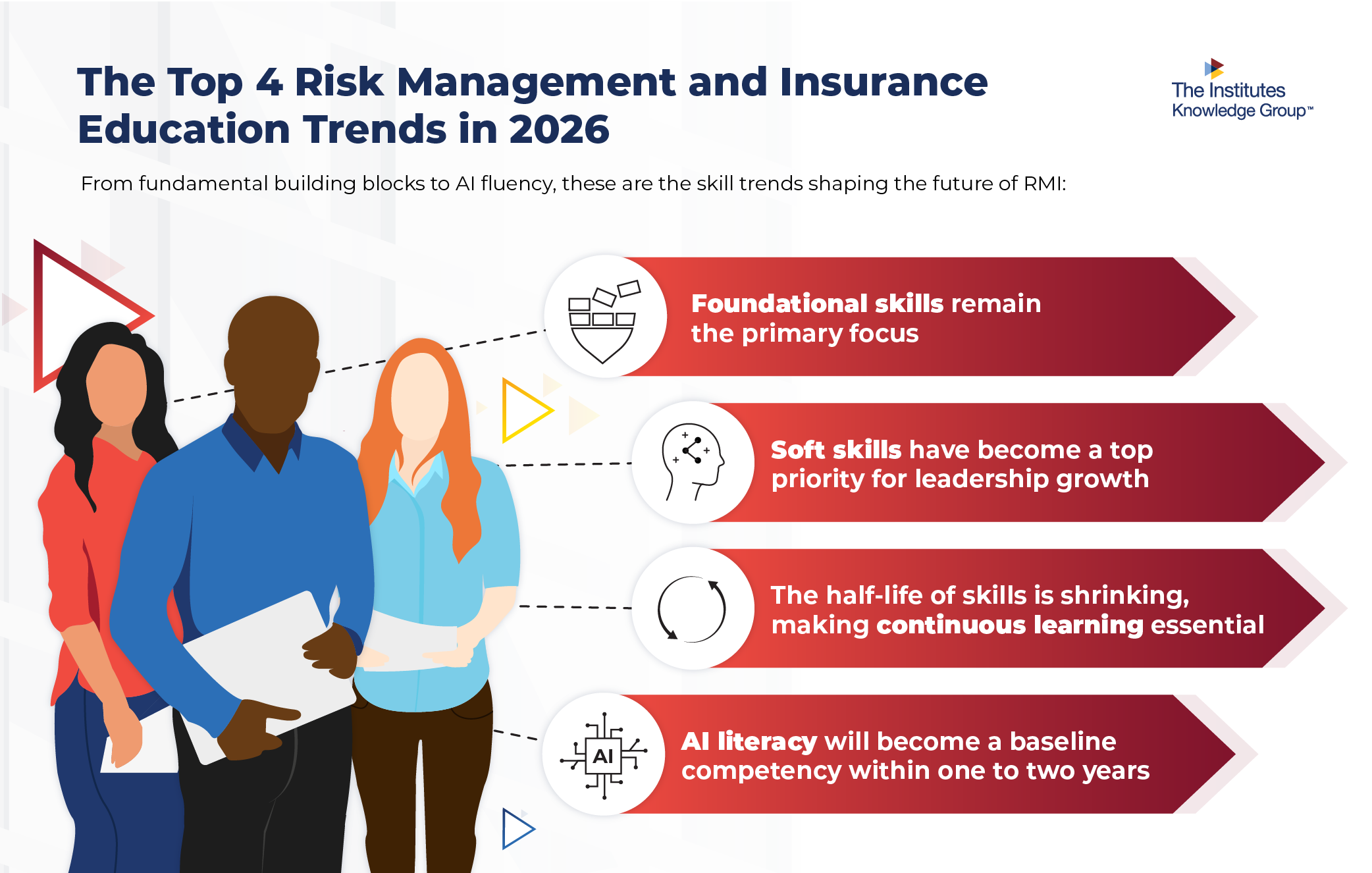
Based on The Institutes Knowledge Group’s 2026 Skills Report, the four most significant insurance education trends are:
- Foundational expertise remains the primary focus for professional development skills
- Soft skills have become a top priority for high-potential leader development
- The half-life of skills is shrinking, making continuous learning essential
- AI literacy is on track to become a baseline competency within one to two years
The sections below break down each trend, what it means for the RMI workforce in the next year, and what L&D leaders can start doing for their organization today.
Trend 1: Foundational Insurance Skills Are Still the Primary Focus
Insurance fundamentals, claims, and risk management ranked as the top skill categories among learners in the past year. This reflects a widespread workforce transition: RMI organizations are onboarding new employees at scale and investing in getting them up to speed fast.
Looking ahead: The focus will shift from building foundational competency to deepening it. Those who have already established core skills will be looking for their next steps, and the organizations with a clear professional growth pathway will be the ones that attract and retain top talent.
What L&D leaders can do today: Establish an early career learning pathway that guides new employees from foundational insurance education into deeper expertise within high-demand specialties.
For example, risk managers who are looking for a natural progression after completing The Institutes Designations’ Associate in Risk Management (ARM™) will likely find value in courses like:
- ACRM 401: Effectively Managing Cyber Risk
- ACRR 401: Responding to Natural Catastrophe Risks
- Associate in Insurance Services (AIS™)
Trend 2: Soft Skills Are a Top Priority in RMI Professional Development
Leadership and strategy, communication and collaboration, and ethics and integrity were the three most sought-after soft skill set categories among learners in the past year. The most effective RMI professionals are combining technical RMI expertise with transferable skills like strategic thinking, customer service, and emotional intelligence. Deep RMI knowledge makes these soft skills more powerful: it's difficult to actively listen to a client's challenges without understanding the coverage issues at stake, or to effectively lead a team without grasping the technical complexities they navigate every day.
Looking ahead: High-potential leaders in RMI will increasingly be identified and developed not by technical credentials or soft skills alone, but by their ability to bring both together. Those who can apply RMI expertise with strong communication, ethical judgment, and strategic thinking will stand out in a competitive talent market.
What L&D leaders can do today: Offer a variety of leadership training that intentionally integrates RMI knowledge with soft skill development. 50% of survey respondents said a combination of self-study and in-person training programs works best for emerging leaders, according to The Institutes’ Enterprise Research team. Explore our leadership guide for a wide range of flexible online and in-person options you can incorporate into your leadership skill development efforts.
Trend 3: The Half-Life of Skills Is Rapidly Shrinking
The half-life of a skill is the time it takes for that skill to lose half of its value or relevance. As AI, automation, and data analytics reshape RMI roles, that window is getting shorter, especially for technical skills.
IBM broke down this type of skill durability into three categories:
- Perishable skills (Half-life is < 2.5 years): Specific technology skills that are updated frequently
- Semi-durable skills (Half-life is 2.5 - 7.5 years): Frameworks with base knowledge and problem-solving skills where field-specific tools arise
- Durable skills (Half-life is > 7.5 years): Professional skills like communication, collaboration, and leadership
For L&D leaders, this distinction matters. Technical skills that were current two years ago may already need to be reskilled. Soft skills, by contrast, remain relevant far longer because they’re rooted in capabilities that technology can complement but never replicate. As new key skills emerge, reskilling and upskilling will only grow more essential to individual and organizational success.
Looking ahead: Simulation-based learning is the future of RMI insurance education. Research from the University of Chicago found that experiential learning can lead to retention rates as high as 90%, compared to just 5% from traditional lectures. Immersive, scenario-driven learning dramatically improves both how much professionals retain and how effectively they apply it on the job.
What L&D leaders can do today: Combine practical content with interactive learning to keep your employees’ skills sharp. For example, Masterclasses equip those in RMI with high-demand skills like strategic leadership, communication, and mentoring through formats that go beyond passive reading and recall.
Trend 4: AI Literacy Will Become a Baseline Insurance Education Competency Within 1–2 Years
AI is already reshaping how claims are processed, how underwriting risks are assessed, and how fraud is detected across the sector. But a significant gap remains: Low AI literacy across RMI organizations means many employees struggle to interpret AI outputs or know when human judgment should take precedence. While adoption presents real challenges, the incentives to build AI fluency are becoming increasingly difficult to ignore.
Looking ahead: AI literacy will shift from being a differentiator to a baseline competency across RMI roles within the next 1-2 years. Early adopters of AI fluency as a foundation for all learning (rather than an advanced specialization) will be the ones setting the standard for all other individuals and organizations that follow.
What L&D leaders can do today: Foster company-wide AI understanding by incorporating RMI-specific AI education into your existing professional development programs. Foundational AI online courses give employees across job functions a grounded understanding of how AI is optimizing RMI. For a deeper look into insurance AI, consider adding The Institutes Designations’ Associate in Insurance AI™ (AIAI™) into your learning pathways. This is the first designation of its kind that covers AI specifically in the context of risk management and insurance, offering a structured, practical approach to understanding and applying AI in real-world insurance contexts.
Stay Ahead of Professional Development Skills: Download the Full 2026 Skills Report
Monitoring risk management and insurance education trends is how the best L&D leaders stay proactive rather than reactive. Download our free, full 2026 Skills Report for visual breakdowns of the top skills, courses, and designations, across RMI roles; role-specific predictions for claims, underwriting, and risk management professionals; and even more insights into learner behavior and where the state of RMI skills development is headed.
These insights and courses are backed by The Institutes’ more than 115 years of experience as a not-for-profit, committed to helping individuals and organizations succeed by educating, elevating, and connecting those interested in risk management and insurance to create a more informed, resilient world.

About the Author
Adam Carmichael, CPCU, is President of The Institutes Knowledge Group. He leads the strategic development and delivery of courses and exams for risk management and insurance designation programs. He also oversees new course creation to ensure The Institutes’ education aligns with professional development needs. With more than 25 years in research and assessments, he brings deep expertise in professional development.