achievementadvance-careeralert-bluealert-grayalert-redalert-whitealertarchery-boardarrow-downarrow-rightarrow-uparrows-clock-flatarrows-clockbeginblue-trophybriefcase-flatcalendar-clockcalendarcart-ceucart-iconcart-the-institutes-designationscart-the-institutesWhat You Walk Away Withceuchatwidget-standardChatcheckchecklistcheckmarkchevron-down-graychevron-down-whitechevron-downchevron-left-thinchevron-leftchevron-right-thinchevron-rightchevron-upcircle-closeclipboard-clockclosecompleted-ribbon-flatcompleted-ribboncompletion-time-flatcompletion-timecourse-time-flatcustomerdesktopexpandfree-course-flatfree-courselevel-flatlevellight-bulb-flatlive-courselivemap-markernotificationonline-courseonline-learning-grayonline-learningpdfphoneplay-buttonpluspreorderpricingquote-close-darkquote-closequote-open-darkquote-openrocket-flatrocket-uprole-agents-brokersrole-claimsrole-customer-servicerole-data-scientistsrole-risk-managementrole-underwritingsearch-barsearchskills-flatskillsstarstopwatch-flatstopwatchtarget-flattimertool-tiptrophy-flattrusted-flattrustedvertical-certificatevirtual_certificate_flatvirtual-exam-grayweight-balance

The Skills Edge Blog

Stay ahead in the RMI landscape with expert insights, practical tips, and innovative solutions designed to help you elevate your career and drive organizational success. 

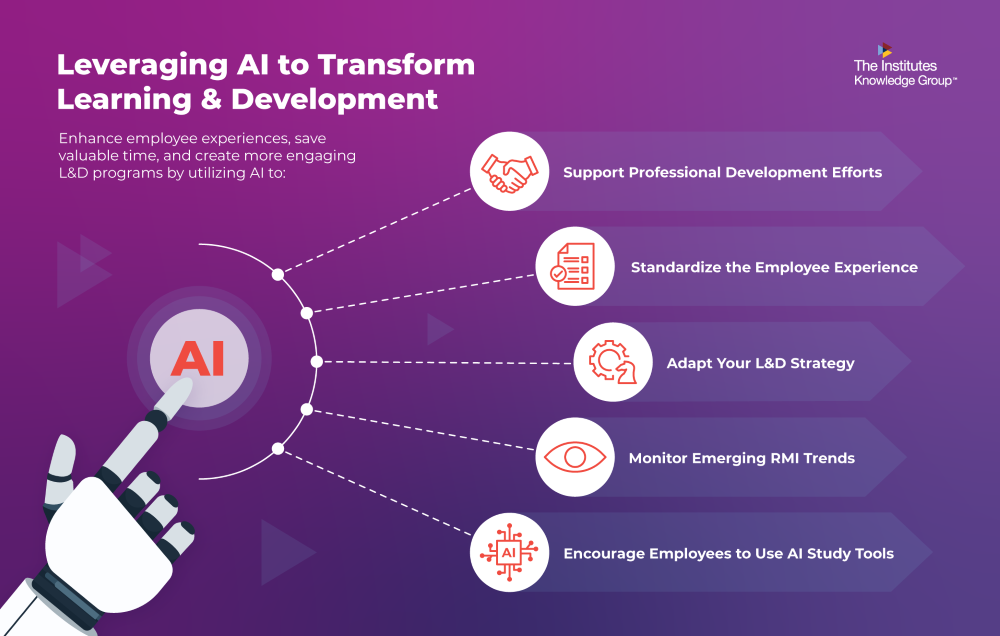
Person typing on a laptop displaying an infographic about automated insurance underwriting data analysis, with a coffee mug and office supplies on a wooden desk.
Featured Post

6 Insurance Training Pathways for Your Team

Diane Hanlon

November is National Career Development Month, a time to celebrate and encourage professional growth and invest in the skills that help employees succeed...

READ MORE
Image
Headshot of a young man with light brown hair wearing a dark suit jacket and light blue shirt against a blue geometric background.
Professional Development

How Earning CPCU Early Can Give Your Career an Edge: Michael Iseminger’s Story 

By Skills Edge Team

If you're a student or early in your risk management and insurance (RMI) career, you may assume a designation can wait until you have more experience. Michael Iseminger, CPCU, CIPP/US, MLIS, decided not to wait. He earned The Institutes Designations' CPCU® at 20, while still in college, as one part of a deliberate plan to build a career in cyber risk.

Today, Michael is a Cyber & Management Liability Apprentice at Higginbotham, where he works across cyber, directors and officers (D&O), errors and omissions (E&O), and professional lines. We asked him why he started CPCU in college, how he made time to study, and what he'd tell a student who is on the fence. Read on for his answers.

Headshot of a young man with light brown hair wearing a dark suit jacket and light blue shirt against a blue geometric background.

Question: Why did you start pursuing CPCU while still in college?

Answer: I started my CPCU journey early because I knew a 20-year-old walking into this industry needs to demonstrate technical depth to be taken seriously. But the true value of CPCU went well beyond credibility. It gave me the mental framework to understand risk across the whole industry, not just one corner of it, and the CPCU Society connected me to a network I wouldn't have had otherwise.

It's recognized everywhere in insurance, which matters, but what I'd tell another student is that the designation makes you a more informed, more capable member of the industry. It doesn't replace the years of hands-on experience it takes to truly master your craft, which I think is the most important piece. Nothing can replace that. But what it does is give you the right tools and the connections to get to that experience faster.

Q: How did you decide which skills and credentials to build?

A: I think about cyber risk as having three pillars: the insurance side, the technology side, and the privacy-law side. CPCU covered the insurance foundation, Security+ covered the technical side, and CIPP/US covered privacy law. I deliberately went after the hardest, most respected designation in each area. As someone young and new to the industry, I couldn't close the experience gap overnight, but I could build demonstrable depth across all three dimensions of the risk I wanted to work in. The credentials were a way to prove I understood the whole problem, not just one part of it.

Q: What have you learned through CPCU that you already use at work?

A: CPCU taught me to read coverage at the level of what's actually triggered versus what's assumed to be covered: the difference between first-party and third-party exposure, how endorsements narrow or expand a grant, where the real gaps sit. In my cyber work at Higginbotham that's been immediately useful, because the whole opportunity in the SME market is that businesses may think they're covered when they're not, which is the gap I've spent much of my time working to close.

But the deeper thing CPCU gave me was the ability to see risks from a macro point of view, understanding how a single account fits into a portfolio, an industry, a market. I've come to believe that's what separates people who are good at this job from people who actually make an impact. At Higginbotham I'm encouraged to think at that level, across cyber, D&O, E&O, and professional lines at once, and that breadth is a big part of why I was drawn to specialty broking. That macro view is the part of the work I enjoy most.

Q: How did you make time to study while balancing college and internships?

A: My approach to completing my CPCU was unorthodox, but it worked for me. Rather than studying a little each day around everything else, I'd wait for a week with no exams or major obligations and then clear the deck entirely: no other coursework, nothing but the CPCU exam I was working on. Blocking out that kind of uninterrupted, single-focus time is what let me move through the exams quickly. I passed every exam I sat for on the first attempt.

I'll be honest that most people can't realistically carve out a full week per exam, so the real lesson isn't the specific method. It's that fully immersing yourself in something is what makes you successful. Purposeful, focused effort is far more meaningful and efficient than just grinding through more hours. Fully diving into one thing beats doing a dozen things halfway. Find whatever version of that fits your life, and that's what will actually move you forward.

Q: How does earning CPCU early give your career an edge?

A: Earning CPCU at 20 isn't something I think of as a finish line. It's a head start that will continue to compound. Most people build this foundation in their late twenties or thirties. Having it now means every experience I take on early lands on top of a framework that's already there, so I'm learning faster and contributing sooner than I otherwise could.

At Higginbotham that's already playing out: I'm working across cyber, D&O, E&O, and professional lines while developing cyber as my specialty, and I can do that partly because the coverage foundation is already in place. Long term, what draws me is the strategic side of specialty risk: working at the level where cyber placement is a strategy question, not just a transaction. Looking across the whole book, understanding where the gaps are, and helping shape how the firm approaches the line. That macro view of placement is what I find most interesting, and it's the direction I want to keep growing in.

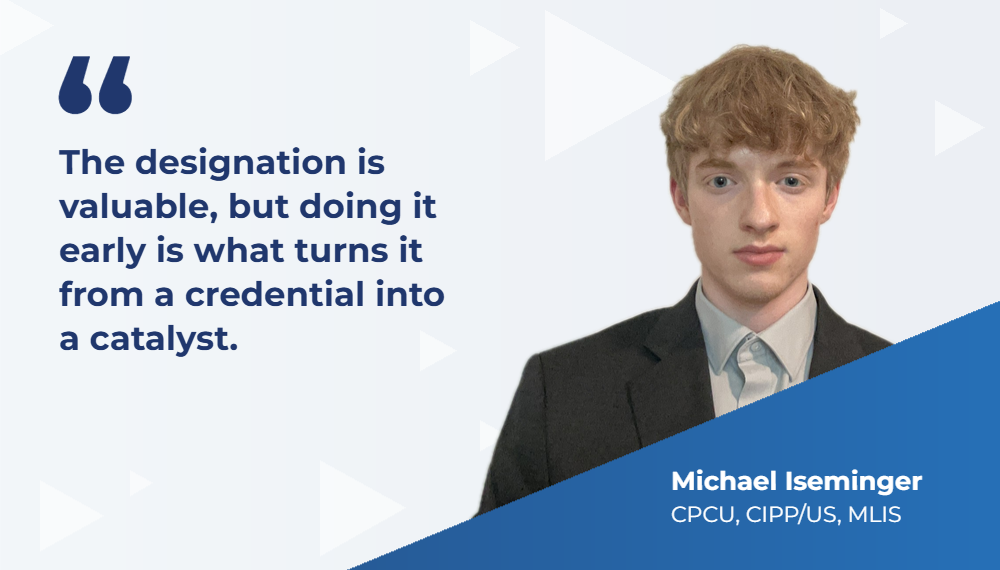
Getting the designation early didn't just open doors; it changed my ceiling. And the CPCU Society keeps that compounding, because the network turns into opportunities I wouldn't have found otherwise. If I could tell one thing to a student on the fence: the designation is valuable, but doing it early is what turns it from a credential into a catalyst.

Start Your CPCU Journey

Michael's story shows what can happen when you build a foundation before you need it. The macro view he describes reflects the critical thinking and strategic decision-making CPCU is designed to develop. You don't have to finish at 20 or clear a full week for every exam to build those skills. What matters is choosing a path that fits your goals and giving it focused effort.

CPCU is the leadership standard in risk management and insurance, and you can start whenever you're ready, including while you're still in school. To earn the designation, you'll complete eight courses plus a free ethics course and CPCU matriculation, which validates two years of experience in risk management or insurance and your commitment to the ethical standards of being a CPCU. The CPCU Society offers study groups, networking, and mentorship along the way. See what's included in the full CPCU experience.

Since 1909, The Institutes have been a not-for-profit focused on helping you succeed in risk management and insurance, wherever you are on your path.

Curious what CPCU looks like? Try the free CPCU sample courses to preview the content before you enroll.

Institutes Skills Edge Team Logo

About the Author

Our Skills Edge Team brings together insurance researchers and subject matter experts dedicated to advancing knowledge in risk management and insurance. Backed by more than 115 years of experience as a not-for-profit, the team at The Institutes is committed to educating, elevating, and connecting people and ideas to create a more informed, resilient world.

Image
Person typing on a laptop displaying an infographic about automated insurance underwriting data analysis, with a coffee mug and office supplies on a wooden desk.
Professional Development

6 Insurance Training Pathways for Your Team

By Diane Hanlon

November is National Career Development Month, a time to celebrate and encourage professional growth and invest in the skills that help employees succeed. For learning and development leaders, it's a good opportunity to look at how your organization approaches insurance education, and whether every employee has a clear pathway to growth within your organization.

That pathway will look different across each team. A new claims hire needs a different foundation than a commercial underwriter preparing to manage a book of business. That's why The Institutes Knowledge Group continuously develops a wide variety of online courses, practical designations, and other insurance education programs to fit the needs of any risk management and insurance professional. Many organizations know us for The Institutes Designations' CPCU®, but that's really just the beginning of what we offer. Our insurance training pathways organize courses and designations around the functions your business depends on, like claims, underwriting, risk management, workers compensation, and more.

Why Insurance Training Pathways Work

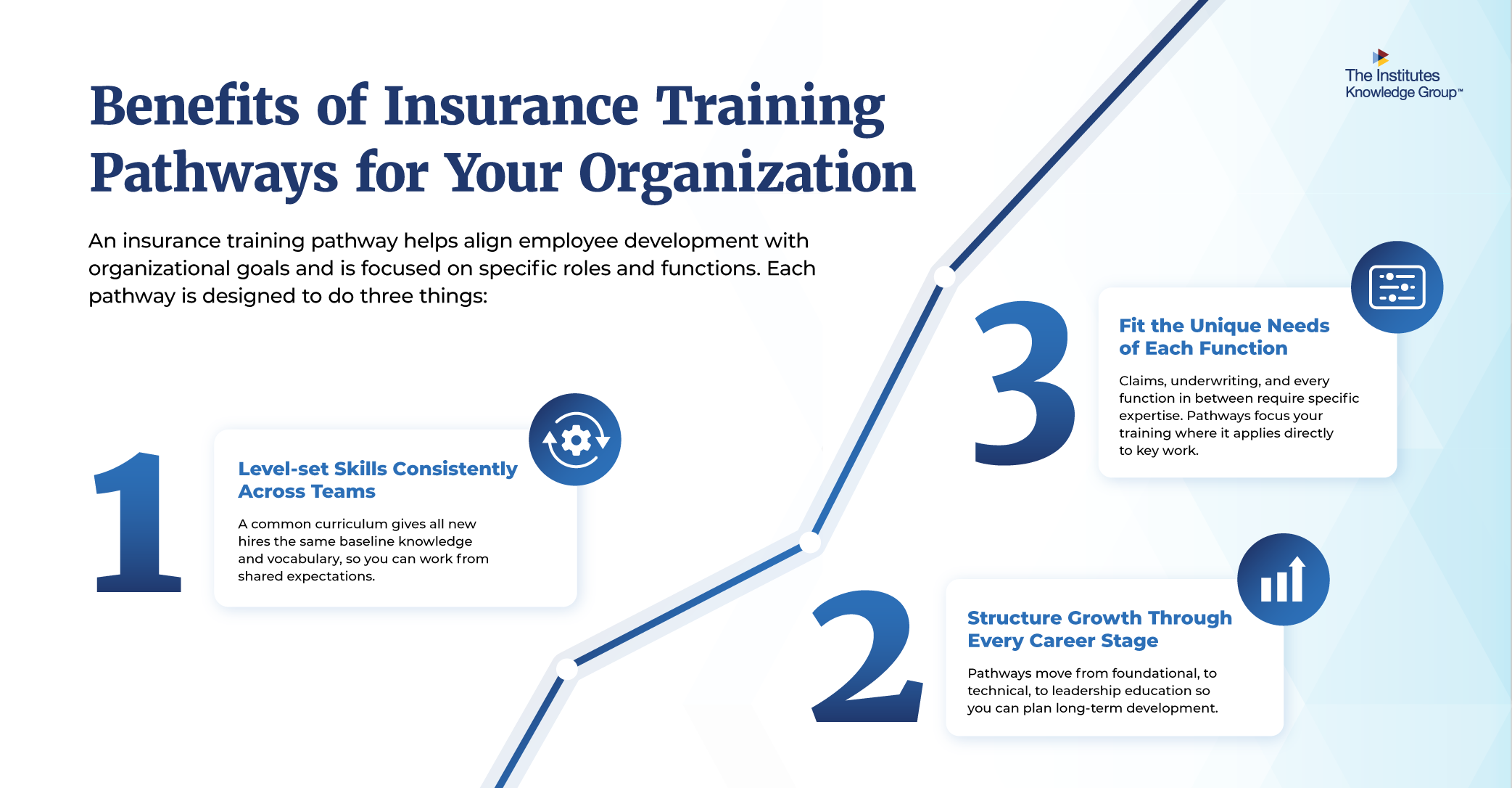
An insurance training pathway helps align employee development with organizational goals, while also offering structured learning that fills in any potential knowledge gaps. Each pathway is built to do three things:

  • Level-set skills across teams. Employees arrive with different backgrounds and experience. A common curriculum can give everyone the same baseline knowledge and vocabulary, so managers can work from shared expectations.
  • Structure growth from early career through leadership. Pathways move from foundational insurance education, to technical designations, to leadership-focused programs, so you can plan development across every stage of an employee's career.
  • Fit the unique needs of each function. Claims, underwriting, surety, and every function in between each demand specific expertise. Pathways focus your training budget where it applies directly to the day-to-day work of your teams.

Explore Insurance Training Pathways by Function

Building an effective development plan is easier when you know where each team should begin. Here's how The Institutes Knowledge Group supports six key functions with the skills your employees need to be successful in their roles.

Claims

Your claims representatives are often the first (and sometimes only) point of contact customers have with your organization, so their expertise directly shapes the customer experience and your brand. New hires need to grow their confidence quickly, and experienced professionals moving into leadership need to build management expertise on top of their technical skills.

The claims learning pathway supports each of those stages. Our programs help claims professionals build on-the-job skills and learn to handle claims in an evolving world, with The Institutes Designations' Associate in Claims (AIC™) at the center of technical development.

Underwriting

Your underwriters decide which risks your organization takes on, so their judgment directly shapes the long-term health of your book of business. New underwriters need to build sound risk assessment skills quickly, and experienced underwriters need to keep pace as automation and AI change how the work gets done.

The underwriting learning pathway supports each of those needs. Our courses and designations build the analytical, technological, and strategic expertise underwriters need to evaluate commercial risks and protect portfolio health, with the new Associate in Commercial Underwriting (AU™) at the core.

Risk Management

Risk management is becoming increasingly critical to organizational strategy as businesses face more interconnected and rapidly evolving risks. Professionals need a firm foundation in proven techniques, while also understanding how AI, data analytics, and automation are influencing how organizations identify, monitor, and respond to risk.

The risk management learning pathway supports each of those stages. At its center is the new Associate in Risk Management (ARM™), which equips your employees with applied risk management skills that help build more resilient risk strategies and improve business decision-making.

Infographic illustrating three benefits of insurance training pathways: consistent skills across teams, structured career growth, and role-specific training, displayed along an ascending blue line.

Workers Compensation

Your workers compensation professionals are on the front lines of a person's worst day, helping injured workers navigate stressful situations while protecting the claimant, the employer, and your organization. As AI and evolving regulations increase the complexity of claims, your team needs to master complex medical and legal terminology, stay compliant with state regulations, and apply strong investigative skills to detect fraud and ensure fair outcomes.

The workers compensation learning pathway builds each of those skills through tailored online courses and the Workers Compensation Claims Administration (WCCA™) designation. WCCA empowers your employees to handle complex claims more effectively and confidently, ensure compliance throughout the process, and facilitate a smooth transition back to work for injured workers.

Operations

Your operations team is the engine of your organization, touching every policy, submission, and service interaction. When your team doesn't fully understand the underwriting and claims logic behind what they process, submissions can get kicked back and errors can lead to rework. And because operations is a common entry point for new talent, high turnover makes consistent foundational knowledge even harder to build.

The operations learning pathway gives your team a shared understanding of how claims, underwriting, and policy administration work together. As part of that pathway, the Associate in Insurance Operations (AIO) designation builds your team's foundation in as little as three months, so they can process submissions faster and more accurately while serving clients with confidence.

Surety

Veteran bond underwriters are reaching retirement and taking their underwriting judgment with them, often with no structured way to train replacements. At the same time, rising claims severity means underwriters need in-depth financial analysis skills that many teams only pick up informally, if at all. Every contract bond balances principal, surety, and obligee, and misreading that relationship increases legal and claims exposures.

The surety learning pathway addresses all those challenges with curated online courses and designations, including the Associate in Fidelity and Surety Bonding (AFSB®). AFSB turns underwriting judgment into a teachable, standardized skill and gives your team the education to evaluate contractor financial health with confidence.

Insurance Education for Every Role

Since 1909, The Institutes have been helping individuals and organizations succeed by educating, elevating, and connecting people in risk management and insurance. That experience shows up in every insurance training pathway, from early career learning pathways to high-potential leadership pathways. And with courses and designations across the functions and markets your organization serves, The Institutes can support every team you're developing.

National Career Development Month is a reminder that growth happens when employees can see where their careers are headed. This November, give each of your teams a clear path to their next step by utilizing The Institutes Knowledge Group's insurance education for every role.

Photo of Diane Hanlon

About the Author

Diane Hanlon is Head of Sales and Market Development at The Institutes, where she leads sales strategy and client partnerships. She works with Learning and Development leaders to design workforce learning pathways and serves on the Board of the Society of Insurance Trainers and Educators.

Image
Headshot of a smiling man wearing glasses, a gray blazer, and a light blue shirt against a blue geometric background.
Professional Development

How a Commitment to Learning Has Shaped Nicholas L. Glaser’s Insurance Career Path

By Skills Edge Team

Some careers in risk management and insurance grow within one specialty. Others move across functions, adding new skills with each step. Nicholas L. Glaser, CPCU, has done both. His insurance career path started in claims and led to commercial underwriting, the agency side, and now agency leadership. Along the way, he's never stopped learning. We asked Glaser what motivates him, how professional development has supported each move, and why The Institutes Designations have stayed part of his plan.

Question: With several designations to your name, what continues to motivate you to keep learning?

Answer: Part of being a professional must include a focus on continuous improvement—both to work toward mastery of your current skill set and to broaden it so you can work as effectively as possible with others across the many parts of your industry (or even in other industries). Professional designation programs have been my way of working toward those goals. Once I had about a dozen or so designations, I challenged myself to keep going and just didn't stop.

Q: Your career has spanned several areas across the insurance value chain. How has professional development supported those transitions?

A: Upon entering the insurance industry full-time after college, I knew I had to pursue the CPCU®. My father is a CPCU, and I understand the gravitas that designation has within the industry. When researching courses with The Institutes, I found other designations focused on specific areas of insurance. Being in claims at the time, I decided to pursue the Associate in Claims (AIC™) in addition to the CPCU. Those courses helped build my knowledge base, enabling me to be a true professional and serve as a go-to resource for others.

I took a kind of hybrid vertical/horizontal career path, which I credit partially to the knowledge gained through designations. In claims, I worked my way up to a senior adjuster before moving over to commercial underwriting. I believe holding the CPCU helped me make the transition from claims to underwriting much more seamlessly.

After several years in underwriting, I was promoted to senior underwriter, then moved to the agency side as an account executive, and now I'm in agency leadership. I completed the Associate in Management (AIM™) designation this year to support my transition into a management position within the agency.

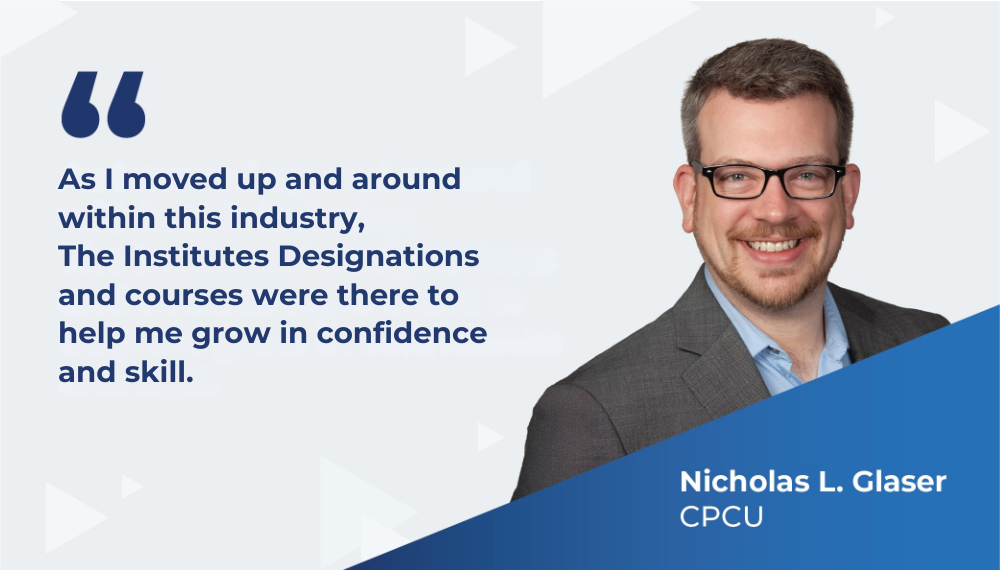
As I moved up and around within this industry, The Institutes Designations and courses were there to help me grow in confidence and skill. My professional development has also gone beyond just designation programs. I served as the 2018 president of the Greater Milwaukee Chapter of the CPCU Society, which helped me grow my leadership skills and spread the value of insurance education.

Smiling man wearing glasses and a gray blazer beside a testimonial about his professional growth, set against a light gray and blue background.

Q: Can you share a specific example of something you learned through an Institutes course or designation that proved especially useful on the job?

A: I honestly have takeaways from every single designation program I've completed. The CPCU offered the broadest application, providing a deep dive into both property and liability insurance and risk management, along with additional education in law, accounting, and operations as they relate to the insurance field. Studying the flood manual to earn the Associate in National Flood Insurance (ANFI®) designation was very helpful for understanding how the federal flood program operates and has been useful in assisting clients who need flood insurance. Most recently, I completed the Associate in Insurance AI™ (AIAI™) program. With AI being a hot topic in our industry, I'm very interested to see where it will go over in the next 4-5 years.

Q: How have you managed to balance studying with your career and leadership responsibilities, and what does your study routine typically look like?

A: Studying is pretty much always done on personal time. I happen to enjoy learning as much as I can about our industry, so it was never a burden for me to fit studying into my personal life to continue my studies. If you aren't using any of your personal time to make yourself a better professional, you will fall behind.

It has been a bit more difficult in recent years with young children at home, but there is still time to fit in studying here and there. For my typical study routine, instead of going through course content linearly, I read chapter summaries first, then take practice exams or chapter quizzes to see which areas I already know and which I need to focus on. Then I can tailor the rest of my studying to only those areas where I'm not already proficient.

Q: What has kept The Institutes Designations part of your professional development throughout your career?

A: The Institutes have designation programs that cover just about every facet of our industry. When curiosity gets the best of me, I've found myself pursuing designations outside my current roles to better understand that part of our business.

For example, while I don't work in a wholesale environment, I pursued the Associate in Surplus Lines Insurance (ASLI™) designation to understand better surplus lines products and how to work more effectively with our wholesale partners to obtain the best coverage for our clients. I also started earning designations in the life, health, and employee benefits spaces to broaden my horizons in this area, including the Professional Employee Benefits Consultant (PEBC™) designation from The Institutes. Learning that side of the business has opened opportunities for cross-selling and working with the benefits folks at our agency. More recently, I've really enjoyed The Institutes' focus on emerging risks and hot topic issues in risk and insurance by earning designations such as the Associate in Cyber Risk Management™ (ACRM™), AIAI, and the Associate in Catastrophe Risk and Resiliency™ (ACRR™). Programs such as these have kept The Institutes at the top of my professional development list.

Keep Learning, Wherever Your Career Goes

Nicholas's story is a reminder that career growth does not always follow a straight line. Each role can reveal new skills to build, new people to work with, and new parts of the field to understand.

For anyone thinking about what to learn next, his path offers a simple place to start: look at the work you are doing now, the opportunities you may want later, and the gaps that curiosity keeps pointing you toward. As a not-for-profit since 1909, The Institutes are committed to helping you build skills at every stage of your career, no matter where it goes.

Ready to plan your next move? Use CourseFinder to find a designation that fits where you want to go.

Institutes Skills Edge Team Logo

About the Author

Our Skills Edge Team brings together insurance researchers and subject matter experts dedicated to advancing knowledge in risk management and insurance. Backed by more than 115 years of experience as a not-for-profit, the team at The Institutes is committed to educating, elevating, and connecting people and ideas to create a more informed, resilient world.

Image
Woman in a sweater sitting at a table looking at a laptop.
Professional Development

6 Tips on How to Prepare for Your Exam in the Final Testing Window of the Year

By Skills Edge Team

From October 15 through December 15, the final testing window of the year is your last chance to complete an exam from The Institutes Designations and end the year with a strong sense of achievement in risk management and insurance (RMI). But it also falls during one of the busiest times of the year, when projects wrap up, holidays approach, and travel plans may fill your schedule.

So, whether it's your first course or the last one you need to earn a credential, success during this season requires a focused yet flexible approach. The tips below will help you create a practical plan, maintain momentum through the holidays, and show up confident on exam day.

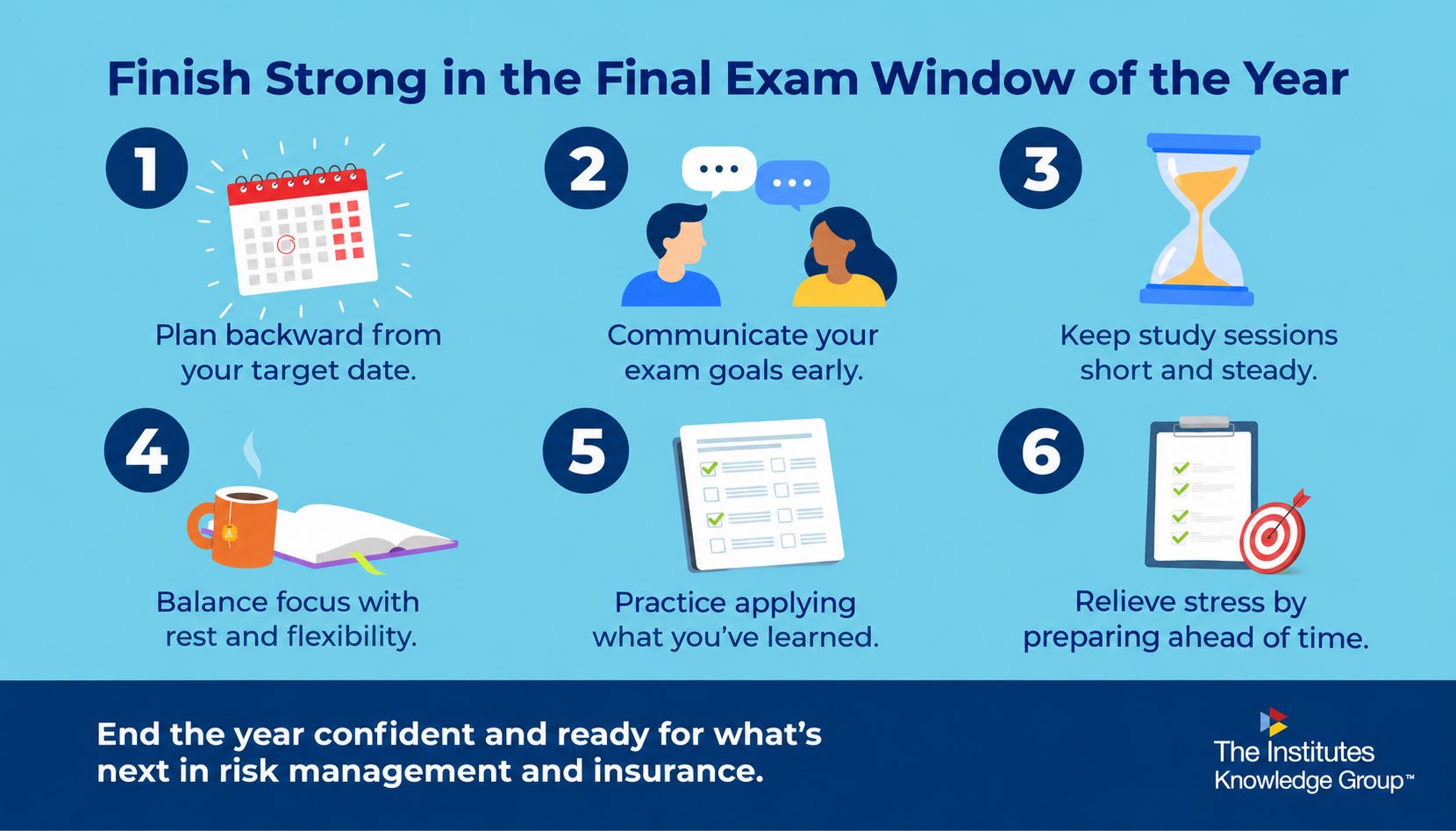
Infographic listing six tips to prepare for The Institutes' final testing window of the year: plan backward from your exam date, build a study routine you can maintain, practice with your exam prep tools, stay flexible through the holidays, save the simulated exam for last, and get ready for exam day.

1. Plan Backward From Your Exam Date

First, pick a target exam date within the October 15 to December 15 testing window, which closes at 11:59 p.m. ET on the final day. Then, plan backward from there. Working in reverse helps you visualize how much time you have for each step, such as reviewing study materials, answering practice questions, and scheduling a lighter review in the final week leading up to your exam.

Mark any major work deadlines, family gatherings, and travel dates on your calendar first. Then, fill the open spaces with study sessions. This method keeps your schedule realistic and prevents conflicts that could derail your preparation. Aim to complete your main studying a week or two before exam day, giving yourself time for final review and some flexibility if you need to retake an exam within the same testing window.

Share your target exam date with your manager or family members early so they can help you prioritize your study time during this busy season.

2. Build a Study Routine You Can Maintain

A study in Memory & Cognition found that retention improved when material was practiced across more sessions. As a starting point, aim for three short study sessions (20 to 30 minutes) and one longer review (60 to 90 minutes) each week. This steady rhythm can help you avoid last-minute cramming.

Try to fit studying into the routines you already have. Review key concepts during a lunch break, discuss a course topic with colleagues, or set aside time for a short study session before or after work. When study time feels like part of your day instead of an extra task, it's much easier to maintain.

3. Practice Applying What You Learn With Exam Prep Tools

The Institutes Designations' exams are designed to measure how well you can apply key principles to professional risk management and insurance situations, not just how much you can memorize. Focusing on the educational objectives in your RMI course materials can help you understand how central themes connect to on-the-job situations.

To put those concepts into practice, use the study tools available in your course to strengthen your understanding and identify areas for review:

  • Practice Questions: Test your understanding with knowledge checks and exam practice questions designed to reinforce key concepts and help you prepare with confidence. When reviewing answers, focus on why an answer is correct and how the concept applies to the situation.
  • Mobile App with Audio: Fit studying into your busy day by reviewing more practice questions and easily accessing audio versions of your course material.
  • AI Learning Support: Ask questions, get explanations, and stay focused with an AI-powered tool built directly into select courses. Check individual course details to see if AI learning support is included.

Explore the exam prep tools and check your individual course for the resources available to you.

4. Stay Flexible Through the Holidays

Create a travel-ready study kit that includes a notebook and noise-canceling headphones to help you focus. This portable setup allows you to review during short breaks or while traveling. Even a few minutes of focused review while waiting at the airport or between family events can reinforce your learning and keep concepts fresh.

However, remember that rest plays a crucial role in memory retention and focus. Try to:

  • Build in short breaks every 30 to 50 minutes during study sessions.
  • Take a brief walk or stretch between sessions to help you recharge and refocus.
  • Prioritize getting quality sleep, especially in the week leading up to your exam.

If stress starts to build, try a short breathing or mindfulness exercise before studying. For a quick reset, try the one-minute breathing practice described in this Psychology Today article.

5. Save the Simulated Exam for Last

Once you've completed your course materials and practice questions, use the simulated exam as a final check before exam day. This timed exam reflects the actual exam's format, timing, and question style, giving you a feel for the experience while helping you check your understanding.

You can take it only once, so save it until you've worked through the other study tools available in your course. Leave time afterward to revisit any concepts that need more attention before taking your actual exam.

6. Get Ready for Exam Day

The Final 48 to 72 Hours: Light Review

In the days leading up to your exam, focus exclusively on light review and confidence-building activities. Review your notes and course materials, and revisit key practice questions you've marked. This is the time to reinforce what you already know, not overload your mind with new concepts.

Double-Check Your Setup

Designation exams use virtual proctoring technology to ensure fairness for all students and maintain the integrity, value, and credibility of your achievements. Review the virtual exam proctoring guidelines and FAQs before exam day. Also, be sure to:

  • Test your camera and microphone at least 48 hours before your exam.
  • Ensure you have a stable internet connection and the latest version of Chrome, Edge, or Firefox.
  • Eliminate potential distractions from your testing space.

Taking care of these technical details in advance allows you to focus fully on demonstrating what you've learned during the exam.

Tip: If a challenging question appears, mark it and return to it later. Maintaining forward momentum helps you stay calm, confident, and in control throughout your exam.

Finish the Year Strong and Start the Next Even Stronger

This final testing window represents your chance to close out the year with pride and enter the new year with stronger skills in risk management and insurance. With a structured plan, flexible study habits, and a calm mindset, you can successfully balance the season's demands while taking the next step toward your designation. With experience as a not-for-profit since 1909, The Institutes are committed to helping you build practical skills in risk management and insurance.

Ready to take your exam? Review the exam information and register through My Courses & Exams.

For more study support, explore:

Institutes Skills Edge Team Logo

About the Author

Our Skills Edge Team brings together insurance researchers and subject matter experts dedicated to advancing knowledge in risk management and insurance. Backed by more than 115 years of experience as a not-for-profit, the team at The Institutes is committed to educating, elevating, and connecting people and ideas to create a more informed, resilient world.

Image
Five business professionals seated around a conference table discussing a document during a meeting.
General RMI Trends & Insights

The Future of Insurance Underwriting: Where AI Meets Human Expertise

By Angela Pilotti, CPCU, ARe

For most of insurance history, an underwriter's role was clear: Assess a risk, determine whether or not to accept the exposure, and set the appropriate price. AI is now reshaping the insurance underwriting process, streamlining routine tasks and creating more opportunities for underwriters to focus on complex risks, strategic decisions, and the human judgement that remains essential to the role.

This means that the most valuable parts of the role still belong to the underwriter. Technology can extract data, triage submissions, and surface patterns at a rate no human can match, but pricing a complex account, questioning a model's recommendation, and weighing how each decision affects the broader portfolio still requires experienced professional judgement. That shift creates a practical challenge for organizations who must now deliberately develop expertise quickly that underwriters once built gradually through years of handling routine files.

What Does an Insurance Underwriter Do?

An insurance underwriter evaluates risk on an insurer's behalf, determining which accounts to write under which terms. In commercial lines, that work includes reviewing broker submissions, analyzing financial and loss information, assessing how an account's exposures interact, and setting the coverage, pricing, deductibles, and conditions that reflect the level of risk.

Underwriters also manage a book of business. Each decision affects the portfolio's loss ratio and growth, so experienced underwriters weigh individual accounts against the carrier's capacity and profitability targets. Historically, much of an insurance underwriter's day went to gathering and organizing that information before any analysis could begin. That's the part of the daily responsibilities AI is changing the fastest.

How is AI Evolving Insurance Underwriting?

AI is moving the field from manual case-by-case underwriting toward a machine-first and human-governed model, according to McKinsey. Automated tools support intake, risk selection, pricing, and issuance, while underwriters direct the process and own the decisions that require true expertise. This leaves more time for them to focus on complex accounts, negotiations, and portfolio strategies.

At the same time, an insurance underwriter needs to know how to govern the models themselves. AI tools learn from historical data, which makes them least reliable for more complex accounts and conditions that have changed since the data was collected. Underwriters need to understand what drives a model's output, recognize when a submission falls outside its limits, and document the reasoning behind any decision to override it. As carriers expand their use of AI, that oversight and attention to detail becomes a core part of the role.

Professional development also shapes retention. In a 2026 Carrier Management survey, 72% of underwriters said an employer's AI strategy would factor into future roles they choose, and 69% said their employer's approach made them more likely to stay.

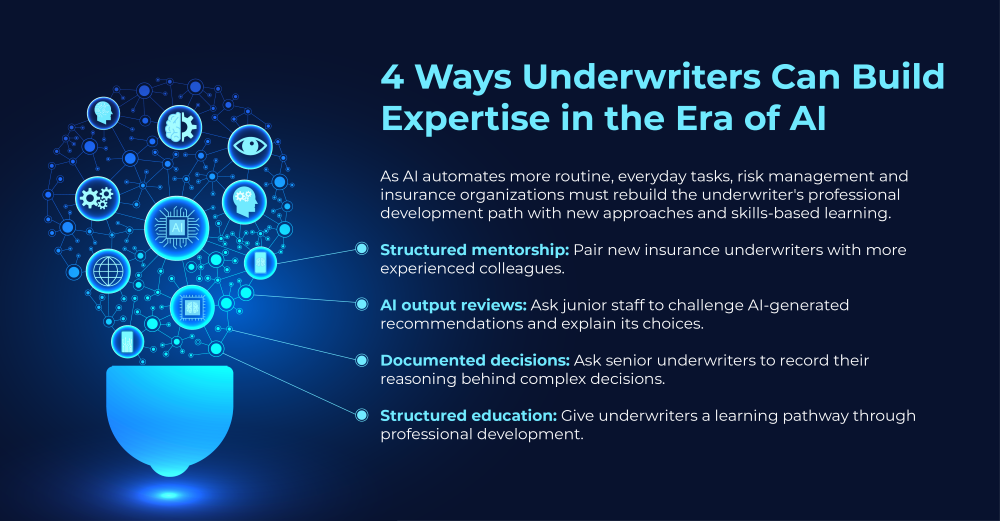
Infographic outlining four ways insurance underwriters can build expertise in the era of AI

How Do Underwriters Build Expertise When AI Handles Routine Work?

Commercial underwriting has traditionally functioned as an apprenticeship: junior professionals develop risk judgement by working alongside experienced colleagues before taking responsibility for complex accounts, according to Triple-I. However, AI is automating many of those entry-level tasks, so insurance companies now need to build that expertise deliberately. Several approaches can help rebuild your underwriters' professional development path.

  • Structured mentorship. Pair each new insurance underwriter with senior colleagues for common types of file reviews to understand the reasoning behind important decisions and before veteran underwriters retire.
  • AI output reviews. Assign junior staff to review and challenge AI-generated recommendations, then explain why a model got an account right or wrong to build the same analytical habits routine files once developed.
  • Documented decision rationale. Ask experienced underwriters to record the reasoning behind complex decisions, creating a reference library that outlasts a single contributor's tenure.
  • Structured education. Give underwriters a consistent foundation in risk analysis, pricing, and portfolio management that on-the-job experience alone no longer guarantees.

How to Prepare Underwriters for an AI-Driven Future

As AI, automation, and increasingly complex risks reshape insurance underwriting, strong human judgement is more important than ever. The Institutes Designations' new Associate in Commercial Underwriting (AU™) equips risk management and insurance professionals to make stronger decisions with modern skills by building the applied analytical, technological, and strategic expertise needed to confidently evaluate commercial risks and ensure overall portfolio health.

AU prepares your commercial underwriters to remain the human in the loop as technology evolves. You can even try AU and see if it's right for your team with this free sample course!

Photo of Angela Pilotti

About the Author

Angela Pilotti, CPCU, ARe, is Head of Education at The Institutes, where she leads the development of innovative learning resources and assessments for risk and insurance professionals. With leadership experience spanning reinsurance, underwriting, and content development, she brings deep expertise to risk and insurance education.

Image
Three professionals in a meeting reviewing risk management strategies displayed on a computer screen.
Risk Management Strategies

How to Build Risk Management Strategies for Better Business Decisions

By Adam Carmichael, CPCU

Your risk management strategies only work if the people who approve them can see the options, the tradeoffs, and the decision in front of them. Making that case is a skill you can put to work right away. In the 2026 State of Risk Oversight study from NC State University's ERM Initiative and AICPA, 74% of executives and board-level leaders said their organizations had experienced a significant operational surprise within the past five years. Effective risk management strategies help you respond more deliberately by selecting the right treatment options and presenting them in terms decision-makers can use.

Read on for the main treatment options, how to choose among them, and how to make the case for what you recommend. And if you want to go deeper, The Institutes Designations' NEW Associate in Risk Management (ARM™) uses realistic business scenarios to help you build more resilient risk strategies.

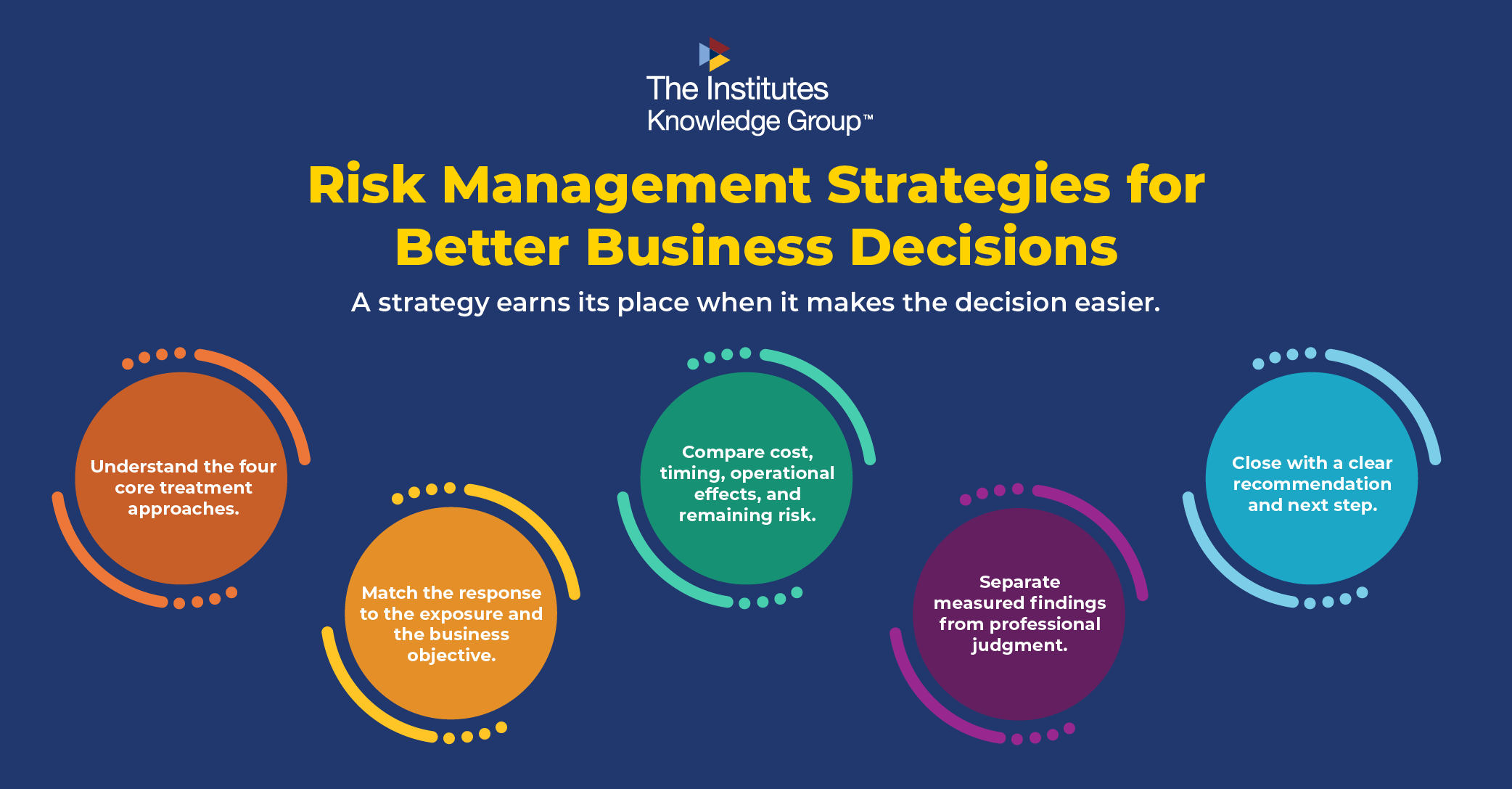
Infographic outlining five risk management strategies for making better business decisions.

What Are the Main Risk Management Strategies?

A risk management strategy is the approach an organization takes to address a specific exposure. Most treatment decisions draw from four core options:

  • Avoidance: Choosing not to begin or to discontinue an activity that creates a particular exposure.
  • Reduction: Using controls to lower the likelihood of a loss, limit its severity, or both. This is where a predict and prevent approach does its work.
  • Transfer: Allocating defined financial consequences to another party through tools such as insurance or contractual agreements.
  • Retention: Intentionally accepting and preparing to finance some or all of the potential loss.

These risk management techniques are not mutually exclusive. An effective strategy often combines several of them so each addresses a different part of the exposure. They also assume the exposure has already been identified and prioritized, which is the job of a risk management framework.

How Do You Choose the Right Combination?

No single treatment works for every risk. Your choice should reflect the likelihood and potential severity of the loss, the organization's objectives and risk tolerance, available capital, the cost and feasibility of controls, and any coverage or contractual obligations.

Consider a distributor concerned about a warehouse fire. It might avoid part of the exposure by no longer storing a particularly hazardous product. It could reduce the likelihood or severity of loss through inspections, safer storage practices, and sprinkler systems. Property insurance could transfer defined financial consequences, while a deductible and funded reserve would retain a manageable portion of the loss. Backup inventory at another location could further limit disruption.

The strongest recommendation is not necessarily the option that removes the most risk. It is the combination that supports the business objective at an acceptable cost while making the remaining exposure clear. Before you recommend an approach, identify what the organization is protecting, what constraints affect the decision, and how much uncertainty remains.

Build the Strategy Around the Decision

A risk report often begins with everything you found. A stronger strategy begins with the decision that needs to be made: Is the organization being asked to approve funding, change a process, revise a contract, select coverage, or accept a defined level of risk?

Once that decision is clear, frame the analysis for the person who must act. Finance may focus on capital, cash flow, and the relative cost of each option. Operations may prioritize continuity, downtime, and implementation demands. Compliance may examine legal obligations and potential penalties. Senior leaders may need to understand the strategic tradeoff and how the recommendation supports broader organizational goals.

The underlying exposure does not change. The framing makes its business relevance explicit. That matters most when you need to guide a decision without controlling the budget, process, or team involved. It is also why enterprise risk management has moved closer to business strategy in recent years.

Make the Tradeoffs Clear

A strong recommendation makes the available choices and their consequences easy to compare. Quantify expected costs and potential losses when credible data is available, but distinguish measured estimates from assumptions and professional judgment. Being clear about uncertainty strengthens your credibility and helps the decision-maker understand how much confidence to place in each figure.

When feasible, present more than one viable approach using consistent criteria. Compare the expected cost, potential loss reduction, implementation time, operational effects, and exposure that would remain. Then recommend the option that best balances those factors.

Close with the specific decision or action needed and when it is needed. A useful recommendation should allow the decision-maker to answer three questions quickly: What are the choices? What does each choice mean for the organization? What needs to happen next?

Build Practical Skills for Better Risk Decisions

The strongest risk management strategies combine sound analysis, business judgment, and clear communication. All three are learnable, and helping students build them is what The Institutes have done since 1909. As a not-for-profit, The Institutes are committed to helping you succeed by educating, elevating, and connecting those interested in risk management and insurance to create a more informed, resilient world.

The NEW Associate in Risk Management (ARM™) develops each of the three skills above through realistic business examples and scenario-based learning. Try the free ARM sample course in as little as 30 minutes so you can see how that works before you commit!

Adam Carmichael Headshot

About the Author

Adam Carmichael, CPCU, is President of The Institutes Knowledge Group. He leads the strategic development and delivery of courses and exams for risk management and insurance designation programs. He also oversees new course creation to ensure The Institutes’ education aligns with professional development needs. With more than 25 years in research and assessments, he brings deep expertise in professional development.

Image
Hand interacting with a digital warning alert surrounded by data and system notifications.
Risk Management Strategies

The New Era of Enterprise Risk Management: From Loss Prevention to Strategy

By Eric Czerwin

A decade ago, risk lived mostly in insurance and loss prevention. Today enterprise risk management sits much closer to strategy, as organizations face increasingly interconnected operational, reputational, and emerging technology risks. As these exposures continue to compound, so does the demand for risk management professionals who can help navigate evolving business challenges.  

Organizational leaders are increasingly turning to risk managers to weigh near-term and long-term exposure with executive-level clarity. In fact, in a recent McKinsey survey of more than 200 senior executives and risk professionals, respondents said risk now plays a broader role within long-term strategy, rather than focusing only on financial concerns. This new level of influence points to a larger shift in how organizations approach risk. Read on to explore how enterprise risk management is becoming a driver of how organizations make decisions, and how you can upskill your employees to support this need.

What is Enterprise Risk Management?

Enterprise risk management, or ERM, is a connected way of managing risk and viewing exposure across your entire organization. Instead of treating risk in a bubble, ERM examines how risks in operations, compliance, finance, and other functions relate to and influence one another. It gives decision-makers a holistic picture of where your organization’s vulnerabilities lie, so risk management becomes part of how you plan for the future.

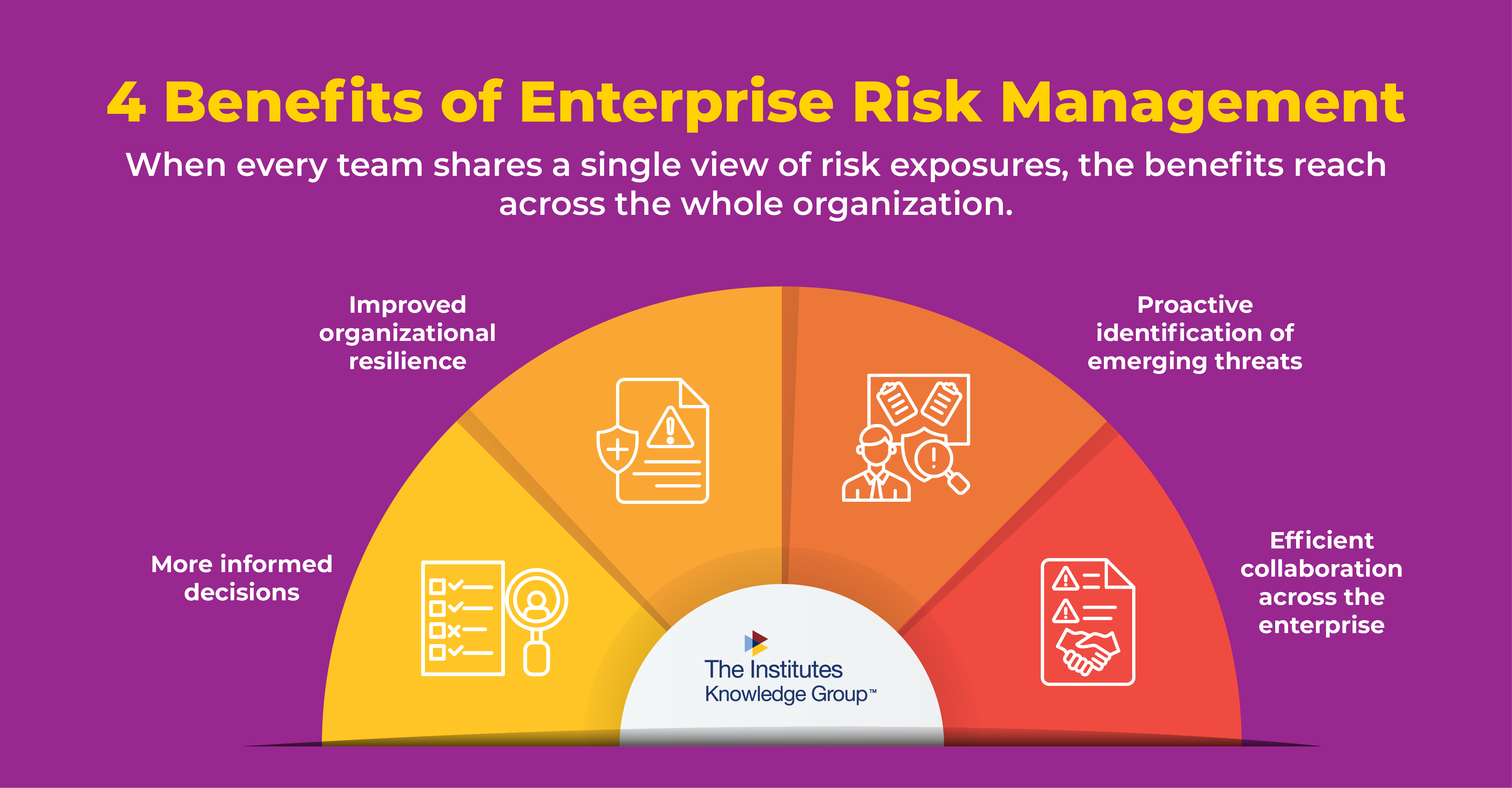
Infographic showing the benefits of ERM

Understanding the Fundamentals of Enterprise Risk Management

At its core, enterprise risk management follows a continuous process that moves from identifying risks, to assessing them, to taking action and tracking the results over time.

Identifying Risk Across Your Organization  

Effective risk management starts with a wide field of view. That means spotting exposures that cross operations, compliance, cybersecurity, finance, and technology rather than focusing on one function in isolation. There are proven techniques to help your team do this, including SWOT analysis, risk registers, and key risk indicators. Remember: risks that look small on their own can carry real weight once you see how they connect.

Assessing and Prioritizing Exposure

Not every risk deserves the same attention. During this step, your team should weigh the likelihood, impact, and near-term versus long-term consequences of a risk event, then analyze it to find the root cause, contributing factors, and points of failure. Framing exposure this way gives decision-makers the executive-level clarity they need to act on what matters most and manage resources with confidence.

Responding and Monitoring With Data

Once priorities are clear, your organization can decide how to treat each risk and then track it over time as conditions change. Be sure to encourage your team to utilize analytics and AI to efficiently and accurately identify exposures, quantify potential losses, predict future threats, and support risk-based decisions as new information arrives. In fact, organizations are already investing heavily in these capabilities, with the digital risk management market projected to grow from $11.89 billion in 2024 to more than $24 billion by 2029.

These fundamental steps provide a high-level overview of what your team needs to do. However, our online course, Executing ERM in Your Organization, shares advice from risk managers and chief risk officers to provide your team with practical strategies for developing your organization's enterprise risk management strategy.

What Are the Benefits of Enterprise Risk Management?

The payoff of a connected approach to risk management goes beyond fewer losses. When teams share one view of exposure, the benefits reach across the whole organization:

  • More informed decisions. Leaders can see how a decision in one area creates risk in another, so they can weigh tradeoffs the business would otherwise miss.
  • Improved organizational resilience. With response plans already in place, organizations can contain a disruption more quickly instead of reacting to it under pressure.
  • Proactive identification of emerging threats. Organizations that are able to predict and prevent threats spend less time and money on damage control.
  • Efficient collaboration across the enterprise. ERM gives operations, compliance, cybersecurity, finance, technology, and leadership a common way to identify and discuss risk, which reduces blind spots and helps teams work toward the same priorities.

Build More Resilient Risk Strategies

Being able to interpret risk data clearly, apply emerging technologies, and collaborate across functions is quickly becoming a baseline expectation for risk managers. Building those capabilities across your workforce is the first step to turning risk management into a real advantage instead of a safeguard.

The Institutes Designations’ new Associate in Risk Management (ARM™) was developed for exactly that need. ARM provides a practical framework that strengthens decision-making, improves organizational resilience, and supports more proactive risk management strategies. By incorporating topics like AI, data analytics, automation, and emerging technology, ARM helps your employees understand how traditional risk management strategies are evolving in today’s business environment. You can even try ARM and see if it's right for your team with this free sample course! 

Photo of Eric Czerwin

About the Author

Eric Czerwin is Director of Sales for The Institutes Knowledge Group. With a background in risk management and underwriting, he bridges strategic insight with practical execution while fostering long-term relationships. His focus is on empowering carrier workforces with enhanced skills and insurance field knowledge through organizational learning and development initiatives.

Image
Homeowners insurance policy displayed next to a laptop showing insurance analytics and performance dashboard.
General RMI Trends & Insights

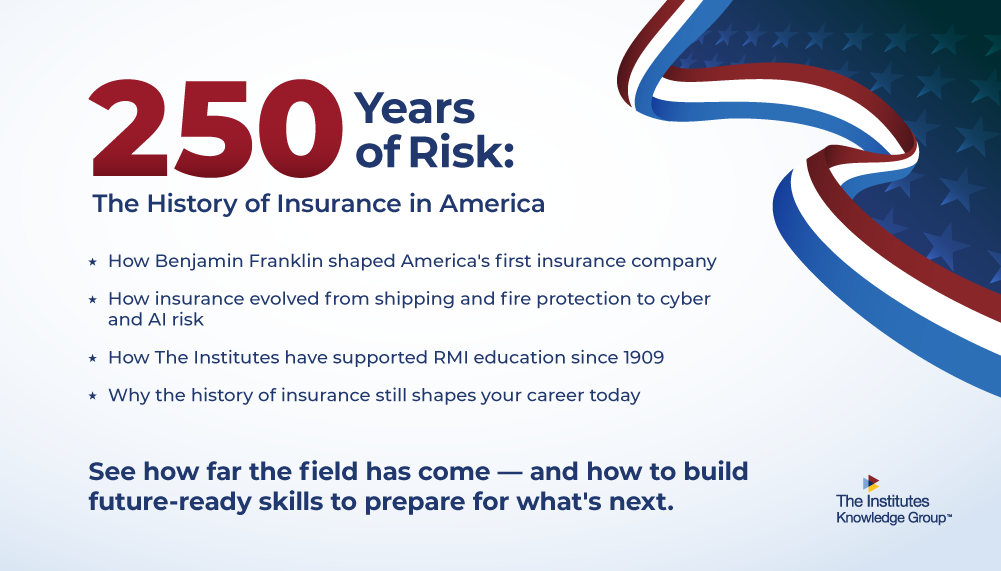
History of Insurance: 250 Years of Risk in America

By Skills Edge Team

In 2026, the United States marks its 250th birthday. It is a natural moment to look back at how people, businesses, and communities have managed uncertainty across those years. The history of insurance is part of that story.

Long before today's complex policies, predictive models, and AI tools, people needed practical ways to approach risk, recover from loss, and protect what mattered. The Institutes have been helping people build those skills in risk management and insurance (RMI) since 1909, nearly half as long as the nation has existed.

The risks have changed. The need for clear thinking, sound judgment, and practical RMI skills has not.

Infographic showing the history of insurance

When Did Insurance Start?

The concept of sharing risk to soften loss stretches back centuries, but modern insurance has clearer roots in maritime trade. As European merchants moved goods across oceans, the need for organized protection against loss at sea became essential.

In the late 1600s, London became a center for that activity. Merchants, ship owners, and those willing to assume risk gathered at Edward Lloyd's coffeehouse, where deals were struck over shipping coverage. Those who agreed to cover a share of the loss signed their name under the policy terms, which is where the term "underwriting" comes from. That system eventually formalized into Lloyd's of London, still one of the most recognized insurance markets in the world.

The principle was simple: share the risk, price it carefully, formalize the agreement. That logic eventually crossed the Atlantic with early American settlers.

How Insurance Took Root in America

In colonial America, fire was one of the most visible risks. Cities were growing, buildings stood close together, and one fire could affect many families and businesses at once.

In 1752, Benjamin Franklin and his fellow firefighters helped found The Philadelphia Contributionship, often recognized as the nation's oldest successful property insurance company. Organized as a mutual insurance company, it brought policyholders together to share risk.

From the start, insurance was about more than paying after a loss. Buildings were inspected, risks were evaluated, and safer construction was encouraged. Those ideas still show up in underwriting, risk assessment, and loss control today.

What Was the First Insurance Company in America?

The Philadelphia Contributionship is widely recognized as the first insurance company in America. Its founding reflected a clear need: help people recover from fire loss while encouraging better decisions before loss happened.

That balance between protection and prevention remains central to RMI. Whether you work in claims, underwriting, risk management, or as an agent or broker, the work often starts with similar questions:

  • What could go wrong?
  • How likely is the risk?
  • How severe could the loss be?
  • What steps could reduce the impact?

The tools have changed. The questions remain familiar.

How Has Insurance Evolved Over Time?

The history of risk management and insurance evolution in America is closely tied to the country's own growth. New forms of commerce, transportation, property ownership, employment, regulation, and technology all created new exposures. Over time, RMI became more specialized and more central to how people and organizations make decisions.

Here is a simplified look at that evolution in America:

  • 1750s: Fire insurance and mutual protection. Early property coverage helped communities share risk and recover from loss.
  • 1800s: Commerce, growth, and regulation. As the economy expanded, insurance became more formalized. New Hampshire appointed the first insurance commissioner in 1851, laying the foundation for state-based insurance regulation.
  • Early 1900s: Structured education. As insurance grew more complex, organized education became essential. The Institutes were founded in 1909 to help people build the skills the field was demanding.
  • Today: Evolving risks, evolving skills. Cyber threats, catastrophe risk, data analytics, AI, and changing customer expectations are reshaping the field.

How Have The Institutes Evolved With RMI?

The Institutes have supported RMI education since 1909, nearly half as long as the United States has existed. What began as a resource for property-casualty insurance professionals has grown into a broader education ecosystem built around real-world skills. The Institutes Designations' CPCU®, introduced in 1942, has since become one of the most widely recognized professional credentials as the leadership standard for risk management and insurance.

As the field has changed, what people need to learn has changed with it. The Associate in Insurance (AINS®) builds a strong foundation in insurance principles and how coverage supports people, businesses, and communities. For the future of the field, the Associate in Insurance AI™ (AIAI™) helps you understand AI concepts, ethical considerations, and practical applications in RMI.

When risks change, learning helps you stay prepared.

Why Does Insurance History Matter for Your Career?

Understanding the history of insurance helps you see the purpose behind RMI work. This field is not only about policies, forms, or technical terms. It is about helping people prepare, respond, and recover when uncertainty becomes real.

A few things the past makes clear:

  • Risk assessment helps people make better decisions. From early fire inspections to modern analytics, sound judgment starts with understanding risk clearly.
  • Prevention remains part of the work. Insurance has always worked best alongside steps that reduce the chance or severity of loss.
  • Credibility matters. People rely on RMI guidance during uncertain moments, which makes ethics, accuracy, and judgment essential.
  • Learning helps you keep pace. New risks require new skills, and your ability to build them makes a difference.

Build RMI Skills for What Comes Next

The history of insurance shows a field built around practical problem-solving. From early fire coverage to today's complex risk landscape, the goal has stayed consistent: help people understand uncertainty, reduce loss, and recover when disruption happens.

The risks ahead will keep evolving, but the need for skilled, credible people will not change. When information feels overwhelming, it helps to learn from a source grounded in verified expertise. The Institutes bring more than 115 years as a not-for-profit dedicated to educating, elevating, and connecting anyone interested in risk management and insurance so they can succeed.

Ready to explore your next step? Use CourseFinder to find a learning path that fits your goals, or visit Getting Started to compare options.

Institutes Skills Edge Team Logo

About the Author

Our Skills Edge Team brings together insurance researchers and subject matter experts dedicated to advancing knowledge in risk management and insurance. Backed by more than 115 years of experience as a not-for-profit, the team at The Institutes is committed to educating, elevating, and connecting people and ideas to create a more informed, resilient world.

Image
Professional standing outside a modern office building alongside graphic elements highlighting risk management and insurance industry trends.
General RMI Trends & Insights

Skills in Motion: 4 Insurance Education Trends L&D Leaders Need to Know in 2026

By Adam Carmichael, CPCU

A transformative shift has been reshaping risk management and insurance (RMI) over the past several years. Spurred on by an impending retirement wave, an explosion of AI and machine learning technology, and an urgency to level-set skills across their organizations, learning and development (L&D) leaders are rethinking how to approach continuous insurance education and best equip employees with the right skills to drive success for their organization.  

The Institutes Knowledge Group’s 2026 Skills Report provides skill trends and data-backed recommendations to answer exactly that. In the past year, our global community of learners completed over 170,000 courses and earned more than 10,000 designations across 48 countries. We used that data to create a holistic report that reveals trends reshaping how RMI organizations approach building professional development skills, as well as actionable next steps for L&D leaders.

What Are the Biggest Insurance Education Trends in 2026?

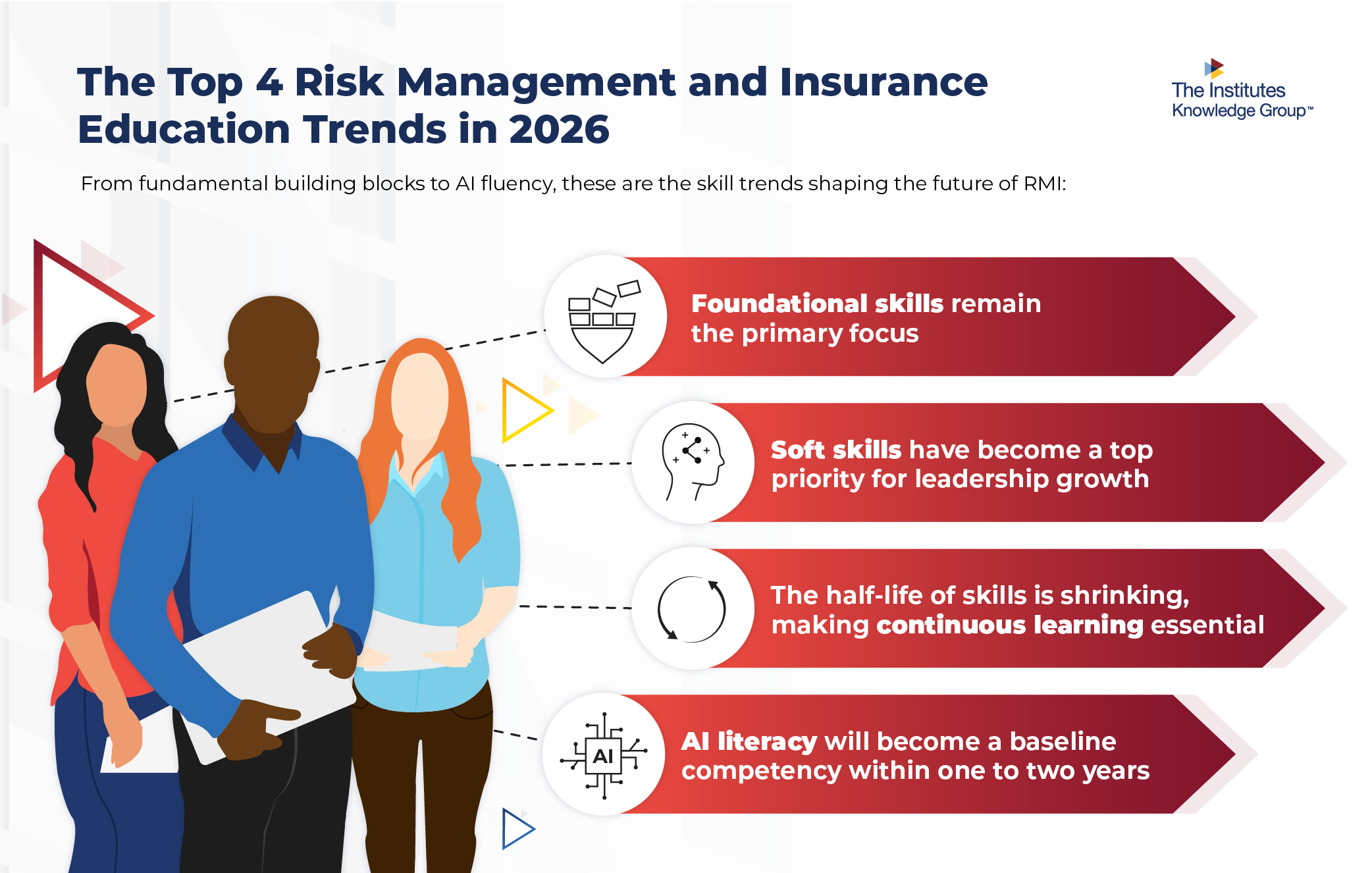
Based on The Institutes Knowledge Group’s 2026 Skills Report, the four most significant insurance education trends are:

  1. Foundational expertise remains the primary focus for professional development skills
  2. Soft skills have become a top priority for high-potential leader development
  3. The half-life of skills is shrinking, making continuous learning essential
  4. AI literacy is on track to become a baseline competency within one to two years

The sections below break down each trend, what it means for the RMI workforce in the next year, and what L&D leaders can start doing for their organization today.

Infographic the top trends in skills for RMI for 2026

Trend 1: Foundational Insurance Skills Are Still the Primary Focus

Insurance fundamentals, claims, and risk management ranked as the top skill categories among learners in the past year. This reflects a widespread workforce transition: RMI organizations are onboarding new employees at scale and investing in getting them up to speed fast.

Looking ahead: The focus will shift from building foundational competency to deepening it. Those who have already established core skills will be looking for their next steps, and the organizations with a clear professional growth pathway will be the ones that attract and retain top talent.

What L&D leaders can do today: Establish an early career learning pathway that guides new employees from foundational insurance education into deeper expertise within high-demand specialties.  

For example, risk managers who are looking for a natural progression after completing The Institutes Designations’ Associate in Risk Management (ARM™) will likely find value in courses like:  

Trend 2: Soft Skills Are a Top Priority in RMI Professional Development

Leadership and strategy, communication and collaboration, and ethics and integrity were the three most sought-after soft skill set categories among learners in the past year. The most effective RMI professionals are combining technical RMI expertise with transferable skills like strategic thinking, customer service, and emotional intelligence. Deep RMI knowledge makes these soft skills more powerful: it's difficult to actively listen to a client's challenges without understanding the coverage issues at stake, or to effectively lead a team without grasping the technical complexities they navigate every day.

Looking ahead: High-potential leaders in RMI will increasingly be identified and developed not by technical credentials or soft skills alone, but by their ability to bring both together. Those who can apply RMI expertise with strong communication, ethical judgment, and strategic thinking will stand out in a competitive talent market.

What L&D leaders can do today: Offer a variety of leadership training that intentionally integrates RMI knowledge with soft skill development. 50% of survey respondents said a combination of self-study and in-person training programs works best for emerging leaders, according to The Institutes’ Enterprise Research team. Explore our leadership guide for a wide range of flexible online and in-person options you can incorporate into your leadership skill development efforts.

Trend 3: The Half-Life of Skills Is Rapidly Shrinking

The half-life of a skill is the time it takes for that skill to lose half of its value or relevance. As AI, automation, and data analytics reshape RMI roles, that window is getting shorter, especially for technical skills.

IBM broke down this type of skill durability into three categories: 

  • Perishable skills (Half-life is < 2.5 years): Specific technology skills that are updated frequently
  • Semi-durable skills (Half-life is 2.5 - 7.5 years): Frameworks with base knowledge and problem-solving skills where field-specific tools arise
  • Durable skills (Half-life is > 7.5 years): Professional skills like communication, collaboration, and leadership

For L&D leaders, this distinction matters. Technical skills that were current two years ago may already need to be reskilled. Soft skills, by contrast, remain relevant far longer because they’re rooted in capabilities that technology can complement but never replicate. As new key skills emerge, reskilling and upskilling will only grow more essential to individual and organizational success.

Looking ahead: Simulation-based learning is the future of RMI insurance education. Research from the University of Chicago found that experiential learning can lead to retention rates as high as 90%, compared to just 5% from traditional lectures. Immersive, scenario-driven learning dramatically improves both how much professionals retain and how effectively they apply it on the job.

What L&D leaders can do today: Combine practical content with interactive learning to keep your employees’ skills sharp. For example, Masterclasses equip those in RMI with high-demand skills like strategic leadership, communication, and mentoring through formats that go beyond passive reading and recall.

Trend 4: AI Literacy Will Become a Baseline Insurance Education Competency Within 1–2 Years

AI is already reshaping how claims are processed, how underwriting risks are assessed, and how fraud is detected across the sector. But a significant gap remains: Low AI literacy across RMI organizations means many employees struggle to interpret AI outputs or know when human judgment should take precedence. While adoption presents real challenges, the incentives to build AI fluency are becoming increasingly difficult to ignore.

Looking ahead: AI literacy will shift from being a differentiator to a baseline competency across RMI roles within the next 1-2 years. Early adopters of AI fluency as a foundation for all learning (rather than an advanced specialization) will be the ones setting the standard for all other individuals and organizations that follow.

What L&D leaders can do today: Foster company-wide AI understanding by incorporating RMI-specific AI education into your existing professional development programs. Foundational AI online courses give employees across job functions a grounded understanding of how AI is optimizing RMI. For a deeper look into insurance AI, consider adding The Institutes Designations’ Associate in Insurance AI™ (AIAI™) into your learning pathways. This is the first designation of its kind that covers AI specifically in the context of risk management and insurance, offering a structured, practical approach to understanding and applying AI in real-world insurance contexts.

Stay Ahead of Professional Development Skills: Download the Full 2026 Skills Report

Monitoring risk management and insurance education trends is how the best L&D leaders stay proactive rather than reactive. Download our free, full 2026 Skills Report for visual breakdowns of the top skills, courses, and designations, across RMI roles; role-specific predictions for claims, underwriting, and risk management professionals; and even more insights into learner behavior and where the state of RMI skills development is headed.

These insights and courses are backed by The Institutes’ more than 115 years of experience as a not-for-profit, committed to helping individuals and organizations succeed by educating, elevating, and connecting those interested in risk management and insurance to create a more informed, resilient world. 

Adam Carmichael Headshot

About the Author

Adam Carmichael, CPCU, is President of The Institutes Knowledge Group. He leads the strategic development and delivery of courses and exams for risk management and insurance designation programs. He also oversees new course creation to ensure The Institutes’ education aligns with professional development needs. With more than 25 years in research and assessments, he brings deep expertise in professional development.

Image
Man is looking at the computer monitor comparing CPCU vs MBA.
Professional Development

CPCU vs. MBA: Which Path Fits Your Career Goals?

By Skills Edge Team

You're ready to take the next step in your career in risk management and insurance (RMI). The question is how. When comparing The Institutes Designations’ CPCU® vs. an MBA, both paths offer real value, but they're built for different outcomes.  

Here’s the short answer: If you want practical leadership skills built specifically for risk management and insurance, the CPCU experience is designed for you. If you’re aiming for broader business exposure across multiple fields, an MBA may be the better fit. Understanding that difference early can help you choose a path that aligns with your goals, your timeline, and the kind of work you want to do next.

What Is the Difference Between CPCU and an MBA?

When you compare CPCU vs. MBA, the biggest difference is how you build and apply leadership skills.

CPCU focuses on the decisions you’re expected to make in risk management and insurance, including identifying exposures, evaluating financial impact, and recommending strategies that affect your organization’s performance, operations, and long-term outcomes. The learning is built around real scenarios that connect directly to risk management and insurance decisions and critical thinking.

An MBA takes a broader approach, combining leadership, strategy, finance, marketing, operations, and organizational management across different business environments. That breadth can be valuable if you’re seeking flexibility across roles or fields, but it is less focused on the specific challenges you face in risk management and insurance.

When making your decision, consider the following: Do you want to deepen your ability to lead within the RMI field, or expand your knowledge across business disciplines more broadly?

Is CPCU Right for You?

CPCU is for anyone who wants to build strategic leadership skills in the RMI field and be able to see across the entire insurance value chain.  

The path is structured but flexible: five core courses, two concentration courses in either commercial or personal lines, one elective, a free ethics course, and matriculation, which confirms you’ve met the experience, education, and ethics standards required of CPCUs.

With CPCU, you will:

  • Develop and hone your critical-thinking skills so you can solve strategic business challenges
  • Lead teams confidently with a solid understanding of how insurer departments connect with one another
  • Develop solutions that address exposures created by the legal system
  • Use ratios and monetary calculations to determine the financial impact of potential strategies
  • Use data to further contribute to the insurance value chain and elevate your organization's competitive advantage

These are the kinds of skills decision-makers rely on every day, and they’re often what set you apart as you move into more complex roles in the RMI field.

Don't just take our word for it...

“I was toying with the idea of getting my MBA or going with The Institutes and doing AIC™, AINS®, or CPCU®. One of my managers was great and sat me down and said, ‘Getting your MBA would be amazing. But if you’re going to stick with [our company] and you’re going to stay in the insurance industry, I highly recommend The Institutes’ programs.’” 

 - Ashley Lawrence, CPCU, AIC, AINS

When Does an MBA Make More Sense?

An MBA may make more sense if your goal is to move across different business functions or fields, or if you’re preparing for a leadership role that requires a broad foundation across finance, marketing, and operations.

It can also be a strong option if you’re earlier in your career and still exploring where you want to specialize, or if your path is not centered on risk management and insurance. And if you do pursue an MBA first, it's worth knowing that MBA holders may be eligible to waive select CPCU requirements.

How Do CPCU and an MBA Compare on Cost, Time, and Prerequisites?

If you’re still weighing your options, a side-by-side comparison can help clarify the differences. The right choice depends on your goals, timeline, budget, and how closely you want your learning to connect to risk management and insurance.

CPCU vs. MBA Features Comparison
FeaturesCPCUMBA
OverviewThe leadership standard in risk management and insurance providing tangible leadership skills you can put into practice right awayA graduate degree used to show your commitment to professional development and learn about a broad array of business topics
Average Cost$6,900$62,500 (Forbes)
Skills & Topics Covered

The core CPCU curriculum provides risk management and insurance-specific skills including:

  • Strategic Leadership
  • Critical Thinking
  • Business Decision-Making
  • Risk Management
  • Strategic Data Analysis
  • Cross-Organization Collaboration
  • And more

The core curriculum of an MBA focuses on general business-related topics including:

  • Accounting
  • Business Strategy
  • Finance
  • Leadership and Management
  • Marketing
  • And more

(MBA.com)

Number of Courses8 courses and exams, plus a free ethics courseAverage of 12 courses, or 36 credits (Grad School Hub)
StructureSelf-study, work at own paceSemesters
Prerequisites for Program

No prerequisites


An accepted application, typically including:

  • Bachelor's Degree
  • GMAT or GRE
  • Resume
  • Transcripts
  • Letters of Recommendation
  • Written Essays

(MBA.com)

Want to see what the numbers look like for you? Use the CPCU vs. MBA calculator to explore cost and time based on how many courses you need to complete.

Cost

CPCU costs approximately $6,900 for courses and exams.

In comparison, an MBA averages around $62,500, according to Forbes. That’s a meaningful difference, especially if you’re balancing education with other financial priorities.

Time

There are eight CPCU courses and exams plus a free ethics requirement and matriculation. It is a self-paced program, so you move at a speed that fits your schedule. Most students complete the designation in 1.5 to 2 years while working full time.  

An MBA typically requires 36 credits, taking about 2 years to complete in a full-time format or 3 years in a part-time format, according to GradSchoolHub.

Prerequisites

CPCU has no prerequisites. You can start whenever you’re ready, whether you’re early in your career or looking to build new leadership skills after years in the field.

MBA programs typically require a bachelor’s degree, application materials, essays, recommendations, and sometimes GMAT or GRE scores. Many programs also value prior professional experience as part of the admissions process.

If you’re ready to start building leadership skills now, CPCU lets you do that without an application process standing in the way.

What Resources Are Available to Pursue CPCU?

The path to CPCU is well supported. Along the way, you can tap into study support, peer connection, and a broader community that helps make the process more manageable and motivating. Here's what's available to help you get started and stay on track:

  • CPCU study materials: You'll have access to self-paced assignments, study outlines, flashcards, quizzes, and a simulated exam.
  • Exam practice questions: Interactive exam practice questions are built to reflect the tone and structure of the real exam, with instant feedback and links back to course content so you can close knowledge gaps as you go.
  • Cross-credits: If you've already completed courses for other Institutes Designations, you may be closer to CPCU than you think. Once you earn your CPCU, it can give you cross-credit toward more than 15 other Institutes Designations as well.  
  • ARM Path to CPCU: For those who want both a risk management foundation and the CPCU leadership credential, the ARM Path to CPCU brings both into one path.
  • Scholarships: Financial support is available through CPCU scholarships, so it’s worth checking before you enroll.  
  • Academic waivers: MBAs and other qualifying degrees may count toward select CPCU requirements through academic waiver opportunities.
  • CPCU Society: The CPCU Society is a global community of risk management and insurance professionals offering networking, career resources, mentorship, and facilitated study groups to support you throughout your CPCU journey and beyond.

If you're interested in exploring education assistance through your employer, this guide to education assistance for RMI professionals walks you through how to identify available support and start the conversation.

Lead the Future With CPCU

Since 1909, The Institutes have helped RMI professionals build the skills they need to succeed. CPCU is one of the most direct ways for you to develop practical leadership skills you can start using right away. You'll also join a community of more than 90,000 CPCU holders who are shaping the future of the field.

An MBA can help you learn about a broad array of business topics, but if your goal is to lead within the RMI field, CPCU aligns more directly with that path.

Still weighing the cost and time commitment? The CPCU vs. MBA calculator gives you an in-depth comparison in seconds. Or, if you're ready to experience CPCU firsthand, try the free sample courses to preview actual course content. 

Institutes Skills Edge Team Logo

About the Author

Our Skills Edge Team brings together insurance researchers and subject matter experts dedicated to advancing knowledge in risk management and insurance. Backed by more than 115 years of experience as a not-for-profit, the team at The Institutes is committed to educating, elevating, and connecting people and ideas to create a more informed, resilient world.

Image
Woman and man in front of laptop reviewing paperwork.
General RMI Trends & Insights

Ethical Risk Management and Insurance in a Changing World

By Adam Carmichael, CPCU

March is Ethics Awareness Month, but ethical decision-making matters year-round, especially as the risk management and insurance landscape continues to evolve. AI, automation, and other emerging technologies are changing how work gets done with greater speed and efficiency. At the same time, they also introduce ethical risks and questions about fairness, transparency, accountability, and trust.

That is why ethics is not a side topic. It is a practical skill that helps you make sound decisions when the path is not always clear. Whether you are evaluating data, communicating with customers, or using new tools in your workflow, ethical judgment helps you move forward with integrity.
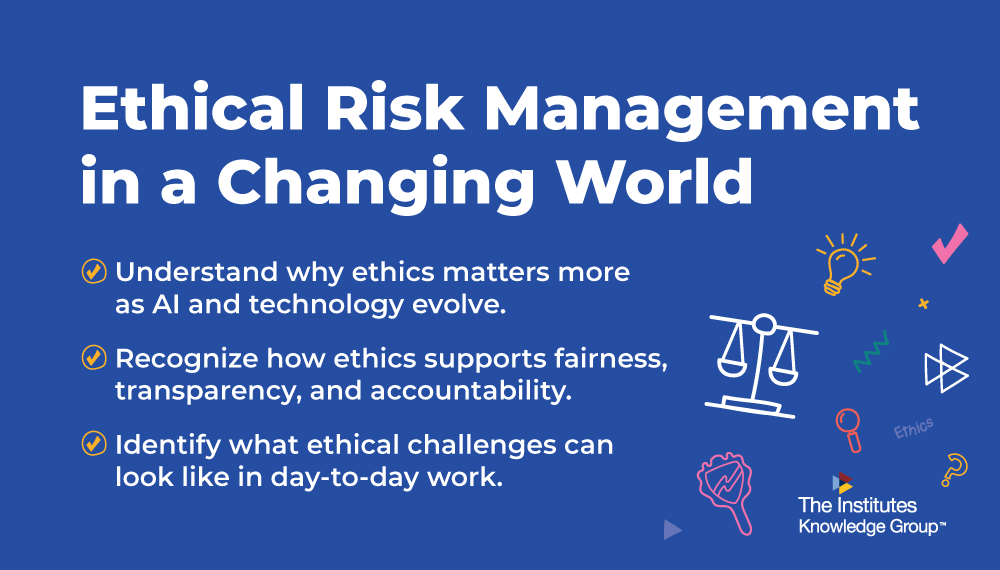
Infographic showing tips on ethics

What Is Ethical Risk Management?

Ethical risk management means making decisions that are not only effective, but also fair, responsible, and aligned with professional standards. In risk management and insurance, your decisions can affect customers, colleagues, organizations, and communities. That makes ethics inseparable from technical expertise.

In practice, ethical risk management is not just about avoiding the wrong choice. It is about building habits that support sound judgment, clear communication, accountability, and trust. Those habits matter even more when you are working with fast-moving technology, complex information, or competing priorities.

For example, you may have access to a tool that helps you process information faster. But using it responsibly still requires you to ask important questions. Is the output accurate? Is the process fair? Can you explain the result clearly to the people affected by it? Those are not abstract concerns. They are part of everyday professional decision-making.

Why Does Ethics Matter More Now?

New technology can help professionals work faster and uncover insights more efficiently. But speed does not replace judgment. In many cases, it raises the stakes.

In their bulletin on insurers' use of AI, the NAIC notes that artificial intelligence can support innovation, efficiency, and accuracy, while also creating risks such as inaccuracy, unfair discrimination, data vulnerability, and a lack of transparency or explainability.

That same balance shows up in broader insurance thought leadership. Geneva Association's report on responsible AI in insurance emphasizes that insurers need clear governance, transparency, accountability, and employee training to use AI responsibly. In other words, innovation works best when ethical decision-making is built into how new tools are introduced, used, and monitored, not added after problems appear.

That matters in risk management and insurance because many everyday decisions now sit closer to questions like these:

  • Is this process fair to the people it affects?
  • Can this decision be explained clearly?
  • Is data being used responsibly?
  • Does efficiency support better outcomes, or just faster ones?

These are practical questions, but they are also ethical ones. As your work within risk management and insurance changes, your ability to navigate them becomes even more valuable.

What Do Ethical Challenges Look Like in Day-to-Day Work?

Ethical considerations are often part of routine work, even when they are not immediately obvious. You might use an AI-assisted output without fully understanding its limitations. You might feel pressure to move quickly while still trying to ensure accuracy and fairness. You might need to explain a difficult decision to a customer who needs reassurance, not just information. Or you might find yourself balancing business goals with responsible judgment when the right answer is not immediately obvious.

These moments may seem small, but they shape trust over time.

That is also why ethics remains so relevant as organizations continue adopting digital tools. New capabilities can improve performance, but they do not eliminate the need for people to ask better questions, apply sound judgment, and communicate with integrity. In fact, the more advanced the tools become, the more important those human skills are.

How Does Ethics 311 Help You Build These Skills?

At The Institutes, Ethics 311: Ethical Decision Making in Risk and Insurance is a free online ethics training course required for all Institutes Designations. It is also approved for state continuing education (CE) credits. It can be completed in just a few hours, only needs to be taken once, and is designed to help you identify and work through ethical dilemmas you may encounter in your day-to-day work.

That matters because ethics is not something to save for later in your career. It is a core professional skill. Technical knowledge helps you understand the work. Ethical judgment helps you apply that knowledge responsibly.

That same focus carries into The Institutes Designations' new Associate in Insurance AI™ (AIAI™), which includes ethics-related content in its courses. As the first designation of its kind focused on AI in risk management and insurance, it helps you apply ethical AI principles so you can spot bias, transparency gaps, and responsible-use concerns. It also helps you recognize AI's limits so you know when AI can support your work and when it should not.

Why Is Ethics 311 Offered for Free?

Making ethics education accessible helps strengthen the profession as a whole. In a field where decisions can shape financial outcomes, customer confidence, and long-term relationships, ethical standards should not feel out of reach.

We offer Ethics 311 at no cost to learners because we believe that ethics should be a shared foundation, not a barrier. When more risk management and insurance professionals have access to a common framework for ethical decision-making, it supports stronger judgment across the profession.

Build Your Ethical Decision-Making Skills Now

Ethics matters in risk management and insurance because the work matters. It shows up in everyday decisions, in conversations with customers, in how new tools are used, and in how professionals respond when the right answer is not immediately obvious.

That is why Ethics 311 remains such an important part of the learning journey at The Institutes. It gives you a practical framework for navigating ethical dilemmas, strengthening accountability, and making decisions with integrity.

When information feels noisy and technology keeps changing, it helps to learn from a source grounded in verified expertise. Backed by more than 115 years as a not-for-profit, The Institutes continue to support learners with education designed for real-world decisions.

Complete Ethics 311: Ethical Decision Making in Risk and Insurance to strengthen your ethical decision-making skills, and visit the Ethics in Risk and Insurance Student Toolkit for additional course information and shareable resources.

Adam Carmichael Headshot

About the Author

Adam Carmichael, CPCU, is President of The Institutes Knowledge Group. He leads the strategic development and delivery of courses and exams for risk management and insurance designation programs. He also oversees new course creation to ensure The Institutes’ education aligns with professional development needs. With more than 25 years in research and assessments, he brings deep expertise in professional development.

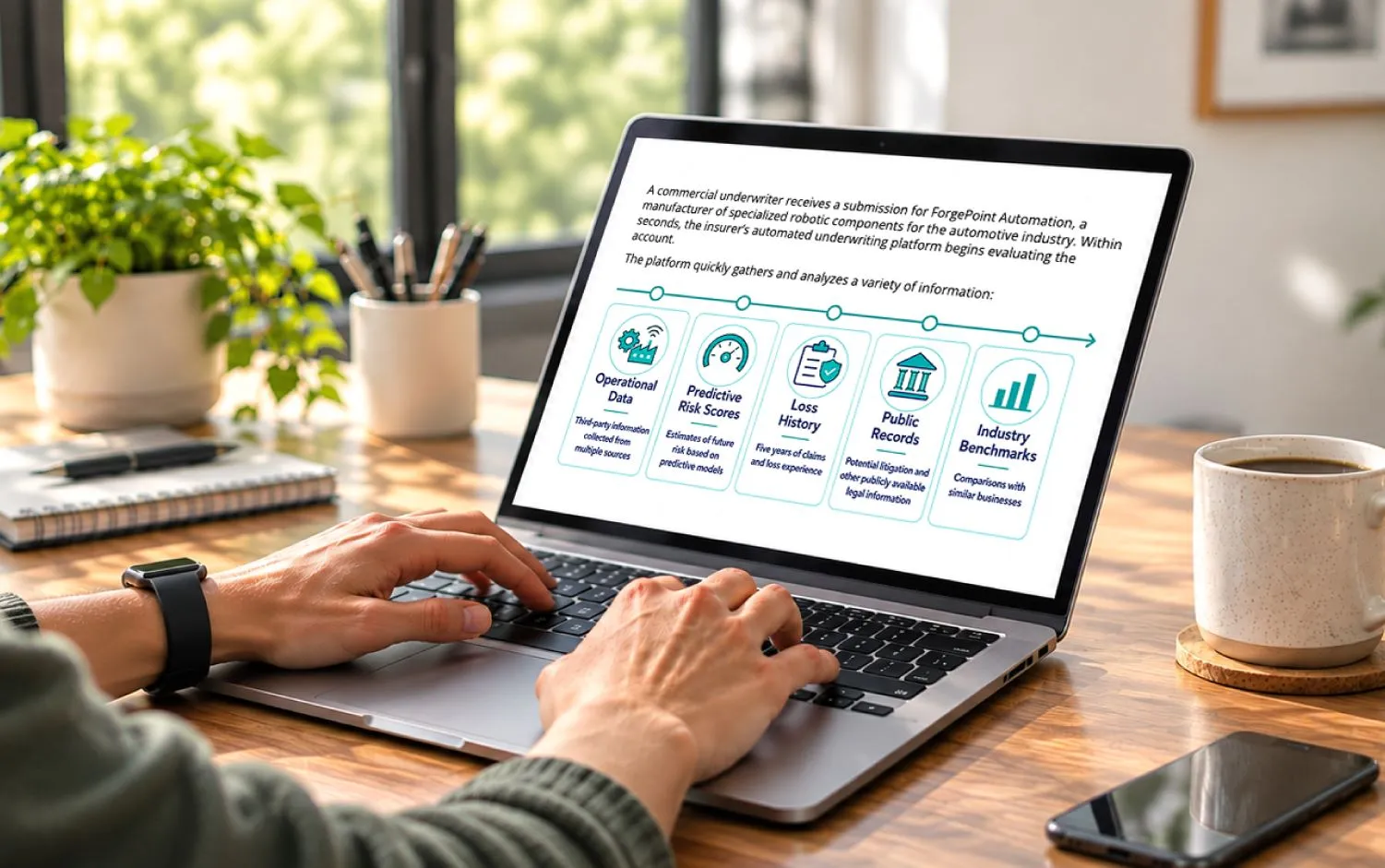
Image
Woman in office typing on a laptop
Emerging Technologies

How Can You Leverage AI in Learning and Development to Enhance the Employee Experience?

By Eric Czerwin

Leverage AI in learning and development efforts to enhance the employee experience by automating repetitive tasks, turning raw data into actionable insights, and helping your team work smarter. It’s no secret that AI is becoming a practical part of organizations’ day-to-day operations, and this is especially true for learning and development (L&D) teams in the risk management and insurance sector.  

For instance, the Global Corporate Training Market was valued at $352 billion in 2024 and is expected to grow at an annual rate of 11.7% until 2030, according to a report from Research and Markets. This growth highlights a clear opportunity: Use AI in learning and development to create more consistent, personalized employee experiences and drive more engagement with professional development programs.

Explore how to use AI in learning and development, from onboarding to exam preparation.

AI Can Support Your L&D Onboarding Efforts

AI can improve L&D onboarding by creating structured, scalable learning experiences that adapt as your organization grows. It can help personalize training, recommend role-specific content, and streamline onboarding workflows to support faster employee ramp-up.

Help Outline Your L&D Onboarding Plan

Effective onboarding begins before a new hire’s first day, and AI can help L&D teams bring more structure to your planning process by mapping learning content to specific roles and business goals. By analyzing job requirements, available learning resources, and historical onboarding data, AI can help identify what training should be introduced early and what can be phased in over time. As priorities evolve, it can also help identify knowledge gaps and suggest updates.

Benchmark Skills Across Risk Management and Insurance Roles

AI tools can help benchmark key skills by analyzing historical performance data and emerging skill trends to define what employees should know within their first 30, 60, and 90 days. New hires often arrive with varying levels of experience, which can make it difficult to set consistent expectations. Benchmarking skills creates a shared baseline across roles while still accounting for specialized technical training in areas like claims, underwriting, or risk management.  

AI Can Standardize the Employee Experience

Standardizing the employee experience makes professional development easier to navigate and more consistent across the organization. When learning requirements, resources, and expectations are clear, employees are more likely to stay engaged and take full advantage of available training opportunities.

Automate Repetitive Tasks

AI can automate repetitive L&D tasks like scheduling training, sending reminders, tracking completions, and generating reports for L&D teams. AI technology is well suited to automate these routine tasks, including:

  • Tracking course completions and learning progress
  • Logging professional development hours and compliance requirements
  • Updating learner records across systems

Plus, implemented AI and automation helps reduce errors, keeps information current, and gives your team more time to focus on more strategic priorities.

Answer Routine Questions in Real Time

Employees usually have similar questions about learning requirements, progress, or next steps—especially as you further standardize their experience. AI-powered tools can deliver immediate answers by drawing from approved learning plans, policies, and FAQs. This ensures employees get reliable information without waiting for manual follow-up. It also reduces the volume of one-off messages that can slow down your team.

Infographic showing how AI helps with learning and development

AI Can Adapt Your L&D Strategy

As the RMI landscape evolves, leveraging AI in learning and development efforts will only become more crucial to deliver relevant and timely training programs.

Monitor Emerging RMI Trends

Regulatory updates, best practices, and skill requirements are constantly changing. AI-driven tools can help monitor emerging RMI trends and identify what skills are becoming most in demand. Rather than relying solely on periodic manual reviews, you can gain a more continuous view of where your L&D strategy may need to shift.

Turn Employee Feedback into Actionable Insights

Employee feedback is invaluable, but analyzing it at scale can be challenging. AI can review all your learning data to surface patterns that might be difficult to identify manually, such as:

  • Common skill gaps across roles or experience levels
  • Courses that consistently drive engagement or drop-off
  • Timing issues, like when learning is introduced too early or too late

These insights help L&D teams move beyond anecdotal input and make decisions based on organization-wide trends.

Build Personalized Learning Pathways

Structured learning pathways are an effective tool to help employees plan their professional development in a way that aligns with your organization’s goals. Further personalizing these pathways to each employee’s personal career goals and interests can make learning feel more relevant and engaging. AI can suggest courses and designations based on role progression, existing expertise, and predictions on future skill trends.

AI Tools and Education from The Institutes Knowledge Group

The benefits of artificial intelligence can extend to your employees' study habits and professional growth as well. The Institutes Knowledge Group is a great example of how to use AI in learning and development to enhance the learning, retention, and skill building for each person.

Interactive Exam Practice Questions

Available in top designation programs, exam practice questions are carefully aligned to the content and format of the actual credentialing exam so your employees can strengthen retention of key concepts. Leveraging the power of AI, employees who are enrolled in a qualifying Institutes Designations course are able to:

  • Access hundreds of questions
  • Get interactive feedback for correct and incorrect choices
  • Link back to relevant course materials
  • Ask follow-up questions using a dynamic chatbot

The Institutes Assignment Assistant

Employees enrolled in a CPCU® or Associate in Claims (AIC™) designation course have access to the AI Assignment Assistant. This study companion offers personalized, assignment-level support that adapts to their study style. Specifically, it offers a variety of activities that help them test their understanding through guided practice, reinforce key terms and definitions, simplify complex topics, and more. Plus, it’s built exclusively on The Institutes’ course content, so employees can be sure they’re getting accurate feedback.  

The New Associate in Insurance AI™ (AIAI™) Designation

AI is already reshaping underwriting, claims, customer experience, and decision-making across organizations, so you need to equip your employees to be future-ready with practical AI skills. The Institutes Designations’ NEW Associate in Insurance AI™ (AIAI™) is the first designation of its kind that covers AI specifically in the context of RMI, offering a structured, practical approach to understanding and applying AI in real-world insurance contexts. AIAI will enable employees to improve their AI literacy and prompt techniques, better interpret AI-driven insights, apply AI across insurance operations, and embed AI into everyday workflows.

AI in Learning and Development: What’s Next

AI and adaptive learning are becoming increasingly valuable tools for L&D professionals looking to create more consistent, engaging, and scalable employee experiences. When applied thoughtfully, it can simplify administrative work, provide meaningful insights, and personalize professional development at every stage of an employee’s journey.  

Essentially, the organizations that see the most value are those that embrace AI to strengthen their L&D programs. Connect with our team at Sales@TheInstitutes.org to learn how our AI-enabled tools and resources support skill development across risk management and insurance.

Photo of Eric Czerwin

About the Author

Eric Czerwin is Director of Sales for The Institutes Knowledge Group. With a background in risk management and underwriting, he bridges strategic insight with practical execution while fostering long-term relationships. His focus is on empowering carrier workforces with enhanced skills and insurance field knowledge through organizational learning and development initiatives.